Can Seed Oils Make You Sunburn More Easily? | Dr. Beata
 Dr. Beata Harasim
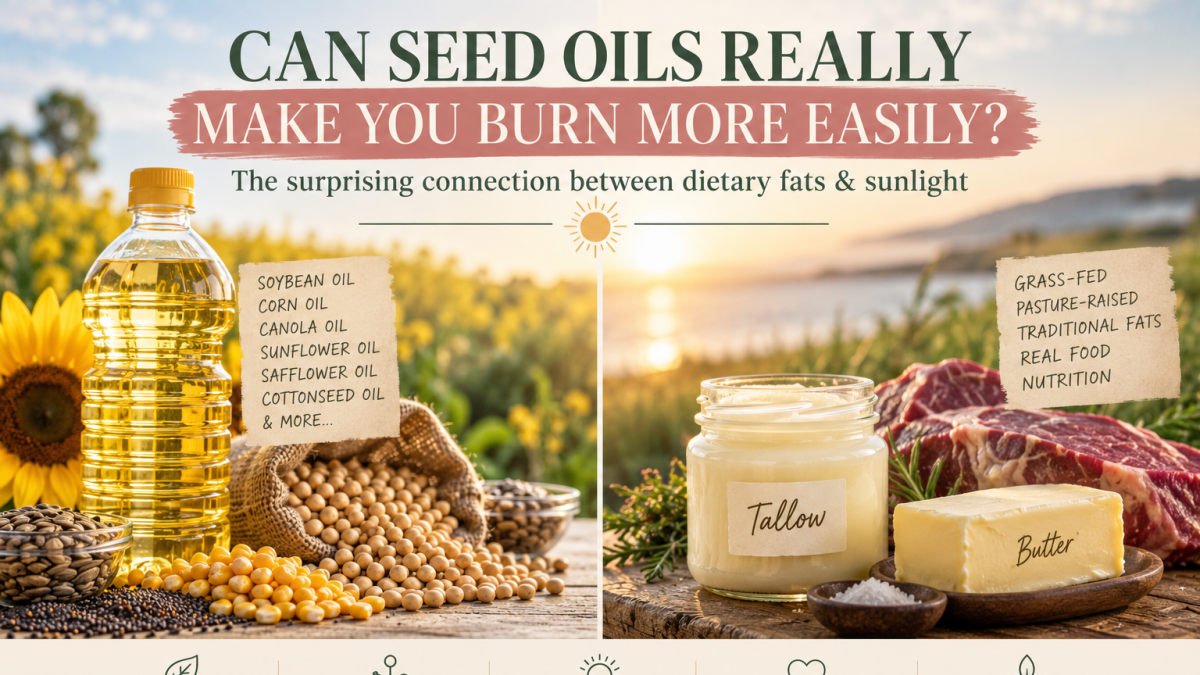
Can seed oils make you sunburn more easily? Explore seed oil processing, oxidation, inflammation, dietary fats, cellular health, and UV exposure.
Can Seed Oils Really Make You Burn More Easily?
What dietary fats, oxidation, inflammation, and cellular health have to do with the way our skin responds to sunlight.
There’s a claim circulating in the natural-health world that sounds pretty wild the first time you hear it:
Stop eating seed oils and you won’t get a sunburn.
I haven't eaten industrial seed oils in years.
And this summer?
I still got sunburned. 😂
Not a tiny bit pink. Actually burned.
I accidentally fell asleep on a beach in Cape Cod for hours on a cool, cloudy day and gave my skin far more UV exposure than it could handle.
So no, eliminating seed oils didn't make me sun-proof.
But I also don't look at that sunburn and conclude that the fats I've eaten for years had nothing to do with how my skin handled that exposure.
I believe I would have burned much worse if I'd spent those years building my cells on a diet dominated by highly refined, oxidation-prone oils and processed foods rather than traditional fats and nutrient-dense foods.
The fats we eat become part of our biology.
Polyunsaturated fats are more susceptible to oxidation.
UV radiation creates oxidative stress and lipid peroxidation within the skin.
Those pieces matter.
Eliminating seed oils didn't make my skin invincible. I believe it helped give my body a more resilient foundation.
And that's the conversation I want to have.
First, What Do I Mean by “Seed Oils”?
When I'm talking about industrial seed oils, I'm primarily talking about highly refined oils such as:
soybean oil, corn oil, canola oil, cottonseed oil, sunflower oil, safflower oil, grapeseed oil, and similar refined vegetable oils.
These oils are everywhere.
Salad dressings. Mayonnaise. Chips. Crackers. Protein bars. Restaurant food. Fast food. Sauces. Frozen meals. Packaged “health foods.”
Even foods marketed as natural or organic can contain them.
They've become such a normal part of the modern food supply that many people are consuming them multiple times a day without realizing it.
And one of the first questions I ask about any food is:
How did this become food? Because processing matters.
Look at How Industrial Seed Oils Are Made
There is a major difference between pressing an olive and collecting its oil, rendering fat from an animal, churning cream into butter...
and producing many of the refined vegetable oils filling grocery-store shelves.
Modern vegetable-oil refining can involve numerous steps, including extraction, degumming, neutralization, bleaching, filtration and deodorization. Bleaching itself can use adsorbents such as bleaching clays, activated carbon or silica to remove pigments, oxidation products and other impurities.
Some oils are also solvent-extracted to increase the amount of oil manufacturers can recover from the raw material.
One commonly used extraction solvent is hexane.
The solvent is subsequently removed during processing, so this isn't an argument that a bottle of refined oil is simply “full of hexane.”
The larger point is this:
I care about what had to happen to a food before it reached my plate.
I choose fats that require minimal industrial manipulation to become food.
Butter doesn't need to be deodorized before I'll eat it.
Tallow doesn't need to be bleached.
Extra-virgin olive oil doesn't require the same industrial refining process as conventional refined soybean oil.
That's meaningful.
If an Oil Has to Be Deodorized, I Want to Know Why
The crude oils produced during industrial processing can contain odors, flavors, free fatty acids, oxidation products and other compounds manufacturers don't want in the final product.
Refining creates a more neutral, standardized, shelf-stable oil.
But refining isn't nutritionally invisible.
Research documents changes and losses in naturally occurring compounds during vegetable-oil refining.1
“Vegetable oil” and “vegetable” shouldn't automatically occupy the same health halo.
The name on the bottle tells you very little about what happened between the plant and the finished oil.
Then There's the Plasticizer Problem
This is another piece of the conversation most people have never heard about.
Oils don't magically move from a seed into a glass bottle.
During production they can come into contact with:
machinery, tubing, storage containers, transportation systems, packaging, and plastics.
And oils are particularly relevant when we're talking about certain environmental contaminants because many of these compounds are lipophilic.
They have an affinity for fat.
Researchers have detected phthalates—chemicals widely used as plasticizers—in numerous edible oils.
One global investigation detected several phthalates across olive, rapeseed, peanut, sesame, tea-seed, corn, soybean, sunflower and blended oils.2
A systematic review of phthalates in foods found contamination can occur at multiple points in the production chain and identified fats and oils as an important food category for several phthalates. Migration can be influenced by factors including temperature, contact time and the fat content of the food.3
More recent research continues to describe edible oils as particularly relevant because the lipophilic properties of phthalates favor their transfer and retention in lipid-rich environments.4
Does that mean plasticizers are intentionally added to seed oils?
No.
Does it mean seed oils are the only foods exposed to them?
Absolutely not.
It means processing, transportation, storage and packaging are part of our food story too.
Our Total Environmental Load Matters
We encounter environmental chemicals from countless sources.
Food packaging. Water. Air. Household products. Personal-care products. Plastics. Pesticides. Building materials.
Our bodies have sophisticated systems for processing and eliminating compounds we encounter.
But I don't use that as a reason to ignore unnecessary exposures.
I reduce the load where I reasonably can.
The fats I put into my body are one of those choices.
So I make that choice intentionally.
Can You Even Trust a Label That Says “Avocado Oil”?
Here's where this conversation becomes even more important.
Maybe you've already decided to avoid industrial seed oils.
You read ingredient labels.
You spend more money on products made with avocado oil.
You choose the chips, mayonnaise, or salad dressing that say it's made with avocado oil.
And you assume: If the label says avocado oil, that's what I'm eating.
Unfortunately, recent research suggests it may not be that simple.
Avocado Oil Is Having a Major Authenticity Problem
In July 2026, researchers at UC Davis published some pretty remarkable findings.
They tested 54 processed foods marketed as containing avocado oil and found that 48 of them—89%—contained other oils.
Among the products tested:
93% of the chips contained other oils.
71% of the mayonnaise contained other oils.
And 100% of the salad dressings contained other oils.
These weren't simply products with another oil clearly listed alongside avocado oil.
The researchers specifically examined products in which avocado oil was presented as the oil ingredient on the label.5
That's a problem.
Because people are paying a premium for these foods specifically because they don't want the cheaper oils they're trying to avoid.
And this isn't the first time avocado oil has come under scrutiny.
UC Davis researchers found problems with bottled avocado oil as far back as 2020. In that study, the majority of commercial samples were oxidized before their expiration date, and researchers confirmed adulteration—including three samples containing soybean oil at levels approaching 100%.6
A follow-up investigation of 36 private-label avocado oils found that only 31% were pure and only 36% met their advertised quality.7
This isn't some fringe internet rumor anymore.
Avocado oil authenticity has become a legitimate food-quality issue.
And Now Regulators Are Paying Attention
This story became even more relevant in August 2026.
The Texas Attorney General announced an industry-wide investigation into companies marketing products as being made with avocado oil following concerns that some products may contain undisclosed seed oils or other ingredients not identified on their labels.
The investigation includes several major food companies.
It's important to distinguish an investigation from a finding of wrongdoing. An investigation doesn't establish that a particular company knowingly mislabeled its products—and UC Davis researchers have specifically pointed out that manufacturers themselves may be receiving adulterated oil from suppliers without realizing it.8
But from the consumer's perspective, there's still a very real problem:
You may be intentionally buying a food to avoid one ingredient and unknowingly consuming it anyway.
And that becomes more than a food-quality issue for some people.
For Someone With a Food Allergy, This Matters Even More
This is the part of the story that immediately caught my attention.
Food labeling isn't merely about dietary preferences.
For some people, knowing exactly what is in a food is a safety issue.
If someone is avoiding soy, corn, sunflower, or another ingredient because of a food allergy or significant food reaction, an undeclared oil isn't simply frustrating.
It could matter tremendously.
We've personally experienced foods labeled as being made with “pure avocado oil” that still triggered reactions when other seemingly comparable avocado-oil products did not.
Could I prove from the reaction alone that there was an undeclared seed oil in that particular food? Not exactly.
A reaction by itself can't tell us exactly what ingredient caused it.
But experiences like that are one reason I've learned not to automatically dismiss someone when they tell me:
“I know the label says it's safe, but my body is telling me otherwise.”
And now we have objective research demonstrating that avocado-oil adulteration really does happen.9
That's an important distinction.
A person's symptoms don't prove adulteration.
But neither does a reassuring label always prove purity.
Sometimes the Body Notices Before We Understand Why
This is something I've seen again and again in the food-allergy world.
Someone eats something that should be safe.
They react.
They check the label again. Nothing obvious explains it.
And they start questioning themselves.
There can be many explanations for a reaction—cross-contact, another ingredient, formulation changes, individual tolerance, manufacturing differences, or something else entirely.
But food authenticity belongs on that list too.
Ingredients matter. Sourcing matters. Manufacturing matters. Cross-contact matters.
And sometimes the story behind a food is more complicated than the ingredient panel makes it appear.
That's why I teach parents and individuals navigating food reactions to become detectives rather than simply memorizing a list of “good” and “bad” foods.
The symptom is a clue.
The question is what that clue is telling us.
Navigating Food Allergies or Reactions?
If you or your child are dealing with food allergies, sensitivities, unexplained reactions, digestive symptoms, eczema, reflux, or other symptoms that seem connected to food, I created a free masterclass to help you begin connecting those dots.
>>> Watch My Free Food Allergies Decoded Masterclass
And I'll be exploring this avocado-oil issue more deeply in a separate article, including what the research has found, why avocado oil is vulnerable to adulteration, what consumers can look for, and why this may matter even more for people navigating food allergies.
>>> Read: Is Your Avocado Oil Really Avocado Oil?
Then We Need to Talk About Oxidation
This is where the conversation becomes especially relevant to sunlight.
Many industrial seed oils contain substantial amounts of polyunsaturated fatty acids, or PUFAs.
Polyunsaturated fats contain multiple carbon-carbon double bonds.
Those double bonds make them more susceptible to oxidation than saturated fatty acids.
Heat accelerates oxidation. Oxygen matters. Light matters. Storage matters. And repeated heating matters tremendously.
When PUFA-rich oils are heated—particularly during high-temperature or repeated frying—they can generate numerous lipid-oxidation products, including reactive aldehydes. Research has identified compounds such as acrolein, 4-HNE and other aldehydes in heated vegetable oils.10, 11
What matters is that these fats are susceptible to oxidation, and processing, storage, heat, oxygen and repeated frying create opportunities for that oxidation to occur.
And when you're eating french fries at a restaurant, you probably have no idea how many heating cycles that fryer oil has already experienced.
That matters.
Are Seed Oils Inflammatory?
This is where the conversation usually becomes polarized.
One side says: Seed oils are inflammatory.
The other says: That's misinformation.
Again, human biology deserves a better conversation.
Controlled studies looking specifically at linoleic acid haven't consistently shown increases in several common circulating inflammatory markers.12, 13
That's one piece of evidence.
But linoleic acid in a controlled nutrition study isn't the entirety of what I'm talking about when I talk about industrial seed oils in the modern food supply.
I'm looking at:
how the oil was produced, how it was refined, how it was stored, whether it was oxidized, whether it was repeatedly heated, what oxidation products were created, what food it came packaged inside, how frequently it's being consumed, and what the person's entire diet looks like.
Context matters.
And oxidized, repeatedly heated oil is a different biological question from simply asking whether increasing dietary linoleic acid alone raises someone's CRP without looking at the whole system.
That's the bigger picture I'm interested in.
So What Fats Do I Eat?
Traditional fats.
Butter. Ghee. Tallow. Lard.
The naturally occurring fat that comes with high-quality meat.
Extra-virgin olive oil also has a place in my kitchen—but I primarily use it cold rather than as my cooking fat.
For cooking, I prefer traditional saturated fats such as tallow, butter and ghee.
Heating EVOO can reduce some of the polyphenols and other compounds I specifically value in high-quality EVOO, so I prefer to preserve them and use the oil cold.
And no: I'm not afraid of saturated fat.
We've Been Taught to Fear Saturated Fat
For decades, the story has sounded something like this:
Saturated fat raises cholesterol → cholesterol clogs your arteries → saturated fat causes heart disease.
That message became so deeply ingrained that people began replacing traditional animal fats humans had eaten for generations with highly refined industrial oils and assuming they were automatically making the healthier choice.
This is where conventional medicine has misguided us.
Fat isn't the enemy.
And cholesterol isn't a toxin our bodies are desperately trying to eliminate.
Cholesterol Is Essential to Human Life
Cholesterol has important jobs throughout the body.
It's a structural component of cell membranes.
It's a precursor for steroid hormones.
It's involved in bile-acid production.
And the brain is extraordinarily cholesterol-rich—containing approximately 20% of the body's total cholesterol. Cholesterol is an important component of myelin and normal nervous-system biology.14
We need cholesterol.
We need it for cellular structure.
We need it for hormone production.
We need it in the brain and nervous system.
We need it as part of normal digestive and bile physiology.
The body doesn't manufacture cholesterol by accident.
Atherosclerosis Is Not Grease Clogging a Pipe
The analogy most of us were taught makes the body sound like plumbing.
You eat saturated fat. Your cholesterol goes up. Cholesterol floats through your blood. It sticks to the walls of your arteries. Eventually the pipe becomes clogged.
Human biology is far more complicated than that.
Atherosclerosis develops within living arterial tissue through a complex disease process involving retained and modified lipoproteins, endothelial dysfunction, immune cells, inflammatory signaling, oxidative processes, tissue remodeling and plaque formation.
Inflammation isn't a fringe alternative explanation for atherosclerosis.
Atherosclerosis is recognized as a chronic inflammatory disease, with inflammation playing a central role in plaque development and progression. At the same time, contemporary evidence also implicates arterial retention of ApoB-containing lipoproteins in initiating that inflammatory cascade.15
That's very different from saying- You ate butter and it clogged your artery.
My root-cause approach asks what is happening in the entire biological environment.
The plaque is evidence of a complex disease process—not evidence that saturated animal fat traveled from someone's dinner plate and lodged itself in an artery.
Because a lab value is a clue. It's not the whole story.
That's how I approach health everywhere else, and cholesterol is no exception.
Saturated Animal Fats Have a Place in a Nourishing Diet
When I'm choosing between a traditional saturated animal fat and a highly refined, PUFA-rich industrial seed oil, I'm choosing the traditional fat.
Tallow. Butter. Ghee. Naturally occurring animal fat.
These are foundational fats for nourishment.
Saturated fatty acids contain no carbon-carbon double bonds.
That makes them inherently less susceptible to oxidation than polyunsaturated fatty acids containing multiple double bonds.
That's chemistry, not nutrition ideology.
And it matters when I'm deciding what fat I want sitting in a hot pan.
Then consider what each fat had to go through before it reached your kitchen.
I can render tallow myself. Butter can be made by churning cream.
Compare that with extraction, refining, neutralization, bleaching, deodorization, transportation, storage and potentially repeated high-temperature heating.
I don't consider those nutritionally equivalent choices.
And traditional animal fats have another thing industrial seed oils don't:
We've been eating them for a very long time.
Long before soybean oil, canola oil and other industrially refined oils became fixtures of the modern food supply, traditional cultures were nourishing themselves with the fats naturally available in their environment.
And this is one of the reasons the work of Dr. Weston A. Price has influenced the way I think about food.
What Weston A. Price Observed About Traditional Diets
In the 1930s, dentist and researcher Weston A. Price traveled around the world studying populations still eating their traditional diets.
He wasn't studying one universal diet.
The foods varied tremendously depending upon geography and culture.
But one of the patterns he documented was the importance traditional cultures placed on nutrient-dense animal foods and naturally occurring fats.
The Weston A. Price Foundation's synthesis of his work describes traditional diets as including animal foods and fats, with organ meats and fats often highly valued. It also describes traditional dietary fat as coming predominantly from saturated and monounsaturated fatty acids rather than the large quantities of refined polyunsaturated vegetable oils common in the modern food supply.16
But one of Price's most fascinating observations wasn't simply about the amount of fat people ate.
It was about what came with that fat.
Price Was Fascinated by Fat-Soluble Nutrients
Price found that the traditional diets he studied were remarkably rich in nutrients carried by foods such as butterfat, organ meats, eggs, fish eggs, shellfish and other animal foods.
He placed particular importance on vitamins A and D, along with another fat-soluble nutrient he called Activator X, which was later associated with vitamin K2.
He was especially interested in butter from cows eating rapidly growing green grass and observed that traditional cultures often went to considerable effort to obtain nutrient-dense foods for growing children, pregnant women and parents preparing to conceive.
That resonates deeply with the way I approach nutrition today.
Fat isn't simply calories.
And food isn't simply a collection of macronutrients.
When we removed traditional animal fats because we became afraid of saturated fat and cholesterol, we didn't simply remove “fat.”
We also changed the foods—and therefore the nutritional packages—we were eating.
Butter isn't just saturated fat. An egg yolk isn't just cholesterol. Grass-fed beef isn't just protein.
Real foods come with an entire matrix of nutrients.
And that's one of the problems with reductionist nutrition.
We isolate one component of a food, label that component “good” or “bad,” and forget to look at everything else the food provides.
Traditional Fats Were Part of Traditional Diets for a Reason
The Weston A. Price Foundation today specifically recommends traditional cooking fats including butter, beef and lamb tallow, lard and poultry fats, along with traditional plant fats such as coconut and palm oils. It contrasts those with highly refined industrial oils such as soybean, corn, safflower, cottonseed and canola oils.17
That distinction is very similar to the one I make in my own kitchen.
I'm not choosing tallow because it has become trendy on Instagram.
I'm choosing a traditional fat that requires very little processing, is naturally resistant to oxidation, and comes from a nutrient-dense food source.
And whenever possible, I take that one step further.
I choose fat from animals raised on organic pasture and eating the foods they're biologically designed to eat.
Because once again: Source matters.
This Is About Returning to Real Food
I don't believe we improved human nutrition when we taught people to fear butter, tallow, egg yolks and the naturally occurring fat on their meat while simultaneously normalizing highly refined oils that require extensive industrial processing to reach our plates.
Real food is more than a saturated-fat number on a nutrition label.
Source matters. Processing matters. Nutrient density matters.
And that’s much closer to the way I approach healing: look at the whole picture rather than isolating one piece.
If you'd like to begin bringing more traditional, nutrient-dense foods into your own kitchen, my Free Real Food Guide walks you through many of the foods I prioritize and includes resources to help you find local grass-fed and pasture-raised farms and food sources.
>>> Download My Free Real Food Guide
Fat Provides Raw Materials the Body Needs
Healing doesn't happen out of thin air.
The body requires raw materials.
Protein. Amino acids. Minerals. Vitamins. Energy. Fatty acids. Cholesterol.
Dietary fat also helps us absorb the fat-soluble vitamins A, D, E and K.
So when I build a healing diet for a client, I build it around nourishment.
Quality matters. Source matters. Processing matters.
And the health and diet of the animal matter too.
Learn more about what to look for in my Free Real Food Guide:
>>> Download The Free Real Food Guide
I Choose Grass-Fed and Pasture-Raised Whenever Possible
What an animal eats changes the composition of the food that animal ultimately provides.
Research comparing grass-fed with grain-fed beef has found meaningful differences in fatty-acid composition. Grass-fed beef generally contains more omega-3 fatty acids and CLA and has a lower omega-6-to-omega-3 ratio. Research has also identified differences in antioxidant nutrients.
The animal's food, environment, and how it was raised matters.
That's why, whenever possible, I choose grass-fed, grass-finished and pasture-raised animal foods.
One of My Favorite Traditional Fats Is Tallow
Tallow is simply rendered animal fat, most commonly beef fat.
You gently heat the fat. The fat renders. You strain it. You let it cool.
That's food processing done natural.
Compare that with extracting an oil from a seed, refining it, neutralizing it, bleaching it, deodorizing it, transporting it, bottling it and potentially heating it repeatedly before it reaches your plate.
Both products may appear under the word “fat” on a nutrition label.
That doesn't make them equivalent foods.
You Can Even Render Your Own
This doesn't have to become another expensive wellness trend.
One of the most traditional things you can do is connect with a local farmer or butcher and source high-quality animal fat.
Ask about suet from grass-fed, grass-finished cattle.
You can render it yourself at home and turn it into tallow for cooking.
You can do something similar with quality pasture-raised pork fat to make lard.
If you don't know where to start, I've included resources in my Free Real Food Guide to help you find local sources for grass-fed and pasture-raised foods and begin building a more nutrient-dense real-food kitchen.
>>> Download The Free Real Food Guide
Sometimes supporting your health doesn't require another supplement.
Sometimes it means reconnecting with real food.
So What Does Any of This Have to Do With Sunburn?
Now we connect the dots.
Your skin is made from what you eat.
It's living tissue—not a covering disconnected from everything underneath it.
Dietary fatty acids become incorporated into cellular lipids.
Different fatty acids have different susceptibility to oxidation.
Then add sunlight.
UV radiation creates reactive oxygen species and oxidative stress within skin and can initiate lipid peroxidation.
So the question is:
How does the nutritional environment we're building within our tissues influence the way those tissues respond when they're exposed to oxidative stress?
That's the question that matters to me.
We don't need a study telling us exactly how many extra minutes someone can spend in the sun after removing soybean oil before we're allowed to connect basic physiology.
The fats we eat matter to the tissues we're building.
Your Skin Is Part of an Entire Biological System
This is the same principle I talk about throughout The Radiant Health Method.
Your skin isn't separate from your gut. Your nutrition isn't separate from your cells. Your sleep isn't separate from your hormones. Your environment isn't separate from your health.
The body is interconnected.
That's why reducing sunburn to sunscreen—or reducing skin health to what we put on the skin—has always felt incomplete to me.
Would My Sunburn Have Been Worse If I Ate Seed Oils?
I believe it would have been.
I haven't eaten industrial seed oils in years. I eat nutrient-dense real food. I use traditional fats. I get natural light year-round. I build my sun exposure gradually. I pay attention to hydration and minerals. I prioritize sleep and recovery.
And I still got burned because I fell asleep for hours and exceeded what my skin could handle.
But I don't interpret that to mean everything I did before that day was irrelevant.
Quite the opposite.
I believe those years of supporting my body gave my skin a stronger foundation for handling the exposure and recovering afterward.
A resilient body can still be overwhelmed.
That's exactly what happened.
>>> Read: Healthy Sun Exposure: What My Sunburn Taught Me
And if you want to know exactly what I did afterward:
>>> Read: How I Supported My Skin After a Sunburn Naturally
I Choose Not to Eat Industrial Seed Oils
Once I learned how industrial seed oils are produced, how vulnerable polyunsaturated fats are to oxidation, and how ubiquitous these oils have become in our food supply, I made the decision to stop eating them.
That includes eating out.
I don't knowingly eat at restaurants that cook with seed oils. I look at menus ahead of time, ask questions, and find restaurants that use fats and oils I'm comfortable eating.
Is that always the most convenient choice?
No. And convenience isn't the only thing guiding my food choices.
There are plenty of exposures in modern life I can't completely control. The food I choose to put into my body is one area where I have a tremendous amount of influence.
So I use it.
At home, I choose traditional fats like tallow, butter and ghee, along with quality extra-virgin olive oil.
When I eat away from home, I learn what restaurants use, what foods are more likely to be prepared with the ingredients I want, and what questions to ask.
Being intentional about your health isn't the same thing as being afraid of food.
It's discernment.
I've learned what I want to put into my body, and I make my choices accordingly.
Eating Out Doesn't Mean Abandoning Your Health Goals
Knowing what to eat at home is one thing.
Knowing how to navigate restaurants, travel, social events, and environments you don't completely control is another.
That's something I teach more deeply inside my Gut Health Accelerator.
You don't have to choose between caring about your health and participating in your life.
You can learn how to make better choices wherever you are.
>>> Learn More About the Gut Health Accelerator
And this comes back to one of the foundational principles behind everything I teach: Health is rarely about one thing.
The fats you eat aren't the whole story.
Nutrition isn't the whole story.
Neither are sleep, stress, movement, environmental exposures, gut health, nutrient status, hormones, the nervous system, or sunlight.
They interact.
I can't control everything. But I take responsibility for the choices I can make.
That's root-cause health.
Connecting the dots—and acting on what you learn.
A Note About Your Individual Health
This article is for educational purposes only and is not medical advice.
Cholesterol, cardiovascular risk, dietary needs, medications, metabolic health and medical history are highly individual. Don't stop or change a prescribed medication based on an article you read online.
If you'd like help looking at your individual health from a whole-person, root-cause perspective and understanding what deserves your attention, that's exactly what my Root Cause Clarity Session is designed to help you begin doing.
>>> Book Your Root Cause Clarity Session
Frequently Asked Questions
Do seed oils cause sunburn?
Sunburn happens when UV exposure exceeds what your skin can handle. But that doesn't mean nutrition is irrelevant to how well your skin handles that exposure.
The fats we eat become part of our cellular environment. Polyunsaturated fats are more susceptible to oxidation, and UV radiation creates oxidative stress and lipid peroxidation within skin.
That's why I don't reduce sun resilience to sunscreen alone.
Will eliminating seed oils stop me from getting sunburned?
No. My own sunburn proves that. 😂
I haven't eaten industrial seed oils in years and still burned after falling asleep on the beach for hours.
But I also believe those years of eating traditional fats and nutrient-dense foods gave my skin a stronger foundation for handling that exposure and recovering afterward.
Supporting your body's resilience doesn't make your body limitless.
Would my sunburn have been worse if I regularly ate seed oils?
I believe it would have been.
That's my conclusion based on what we know about fatty-acid composition, oxidation and UV-induced oxidative stress—not something I can prove by comparing two versions of myself.
What I won't do is assume the nutritional environment of our tissues becomes irrelevant simply because we can't calculate exactly how much difference it made.
Are seed oils inflammatory?
I consider industrial seed oils part of an inflammatory modern food environment, particularly when they're highly refined, oxidized or repeatedly heated.
Controlled studies of isolated linoleic acid haven't consistently raised several common inflammatory markers. That's useful information, but it's a narrower question.
I'm interested in the oil people actually consume: its processing, oxidation, heating, reheating, oxidation products, frequency of consumption, and the ultraprocessed foods that commonly contain it.
A nutrient studied in isolation isn't the same thing as the entire food environment.
Are seed oils rancid?
Not every bottle can accurately be described as rancid. But highly polyunsaturated oils are chemically more susceptible to oxidation, and heat, oxygen, light, storage and repeated frying accelerate oxidative changes. That's one reason I don't choose them.
Are chemicals used to make seed oils?
Many conventional refined vegetable oils undergo extensive processing that can include extraction, degumming, neutralization, bleaching and deodorization; solvent extraction is also used for some oils. The specific process depends on the oil and manufacturer.
Are there plastic chemicals in vegetable oils?
Studies have detected phthalate plasticizers in multiple types of edible oil. These contaminants can enter foods during various stages of production, transportation, storage and packaging, and their lipophilic nature makes fatty foods particularly relevant. This isn't unique to seed oils, but it is one reason processing and packaging deserve attention when choosing food.
Is saturated fat bad for you?
I don't consider traditional saturated animal fats something we need to fear.
Tallow, butter, ghee and naturally occurring animal fats have nourished humans for generations. They're minimally processed, chemically more resistant to oxidation than highly polyunsaturated oils, and can come packaged with valuable nutrients.
When I'm choosing between a traditional saturated animal fat and a highly refined industrial seed oil, I choose the traditional fat.
Does saturated fat clog your arteries?
Saturated fat doesn't travel from your dinner plate into an artery and clog it like grease in a drain.
Atherosclerosis is a complex chronic inflammatory disease involving arterial tissue, retained and modified lipoproteins, immune activity, endothelial dysfunction, oxidative processes and plaque remodeling. Current research supports important roles for both ApoB-containing lipoprotein retention and the inflammatory response that follows.
That's why I look at the person's entire metabolic and inflammatory picture rather than reducing cardiovascular health to a saturated-fat number.
Is cholesterol bad for you?
Cholesterol is essential for life.
Your body uses it in cell membranes, steroid-hormone production, bile-acid production, the brain, myelin and the nervous system.
I don't treat cholesterol as a toxin the body needs to eliminate.
An abnormal lipid pattern is information worth understanding in the context of the entire person.
What fats do you personally use?
I prioritize tallow, butter, ghee and naturally occurring animal fats, ideally from grass-fed, grass-finished or pasture-raised animals.
I also use high-quality extra-virgin olive oil primarily cold rather than for cooking. Heating doesn't automatically make EVOO unhealthy, but it can reduce some of its valuable phenolic compounds, and I'd rather use traditional saturated fats for heat and preserve those compounds in my olive oil.
Do you avoid seed oils when you eat at restaurants?
Yes. My decision not to eat industrial seed oils doesn't disappear because I'm away from home.
I research restaurants, ask questions, and choose better options. I teach more about navigating restaurants, travel and eating away from home inside my Gut Health Accelerator.
Where can I find grass-fed or pasture-raised animal fats?
Local farms and independent butchers are great places to ask about beef suet and other animal fats for rendering.
My Free Real Food Guide also includes resources for finding local grass-fed and pasture-raised food sources.
>>> Download My Free Real Food Guide
Continue Your Radiant Health Journey
Every article is designed to help you better understand your body, connect the dots, and discover what deserves your attention first.
Healthy Sun Exposure: What My Sunburn Taught Me
I hadn't had a real sunburn in years—until I accidentally fell asleep on a cool, cloudy Cape Cod beach for hours.
>>> Read Healthy Sun Exposure: What My Sunburn Taught Me
How I Supported My Skin After a Sunburn Naturally
Fresh aloe straight from the plant was only one piece. See how I supported my skin—and my entire body—afterward.
>>> Read How I Supported My Skin After a Sunburn Naturally
The Benefits of Healthy Sun Exposure
Sunlight isn't simply something to fear. Learn why natural light is one of the fundamental environmental signals our bodies need.
>>> Read The Benefits of Healthy Sun Exposure
Why Eating Healthy Isn't Always Enough to Heal
Food matters tremendously. But healing requires us to look at the entire environment in which the body is trying to function.
>>> Read Why Eating Healthy Isn't Always Enough to Heal
Free Real Food Guide
Want help choosing more nutrient-dense foods and finding local sources of grass-fed and pasture-raised animal foods?
>>> Download My Free Real Food Guide
💖 Dr. Beata “Connecting the Dots” Harasim
References
-
Gharby S. Refining Vegetable Oils: Chemical and Physical Refining. The Scientific World Journal. 2022.
View the research -
Luo Q, et al. Global Review of Phthalates in Edible Oil: An Emerging and Nonnegligible Exposure Source to Human. Science of the Total Environment. 2020;704:135369.
View the research - Costa JM, Kato LS, Galvan D, et al. Occurrence of Phthalates in Different Food Matrices: A Systematic Review of the Main Sources of Contamination and Potential Risks. Comprehensive Reviews in Food Science and Food Safety. 2023;22(3):2043–2080. doi:10.1111/1541-4337.13140.
- Liu S, Wu Y, Shi Z, et al. Phthalate Acid Esters in Water and Edible Oils: A Comprehensive Review of Contamination Sources, Migration Mechanisms, and Emerging Removal Technologies of Food Matrices. Food Research International. 2026;243(Pt 2):120402. doi:10.1016/j.foodres.2026.120402. Epub August 16, 2026.
View the research -
UC Davis. The Avocado Oil in That Chip You’re Eating May Not Be Made of Pure Avocado Oil. 2026.
Read the UC Davis report -
Green HS, Wang SC. First Report on Quality and Purity Evaluations of Avocado Oil Sold in the US. Food Control. 2020.
View the study -
UC Davis. Nearly 70% of Private Label Avocado Oil Rancid or Mixed With Other Oils. 2023.
Read the UC Davis report -
Office of the Attorney General of Texas. Attorney General Ken Paxton Investigates Avocado Oil Products for Deceptive Marketing and Potential Use of Undisclosed Seed Oils. August 20, 2026.
Read the Texas Attorney General release -
Green HS, Wang SC. Purity and Quality of Private Labelled Avocado Oil. Food Control. 2023;152:109837.
View the UC Davis avocado-oil research -
Scianò F, et al. Toxic Aldehydes in Cooking Vegetable Oils: Generation, Toxicity and Disposal Methods. Food Chemistry: X. 2025;29:102744.
View the research -
Abrante-Pascual S, Nieva-Echevarría B, Goicoechea-Oses E. Vegetable Oils and Their Use for Frying: A Review of Their Compositional Differences and Degradation. Foods. 2024;13(24):4186.
View the research -
Johnson GH, Fritsche K. Effect of Dietary Linoleic Acid on Markers of Inflammation in Healthy Persons: A Systematic Review of Randomized Controlled Trials. Journal of the Academy of Nutrition and Dietetics. 2012;112(7):1029–1041.
View the research -
Su H, Liu R, Chang M, Huang J, Wang X. Dietary Linoleic Acid Intake and Blood Inflammatory Markers: A Systematic Review and Meta-Analysis of Randomized Controlled Trials. Food & Function. 2017;8(9):3091–3103.
View the research -
Orth M, Bellosta S. Cholesterol: Its Regulation and Role in Central Nervous System Disorders. Cholesterol. 2012;2012:292598.
View the research -
Zhang F, Liao Q. Inflammation and Lipid-Related Determinants in Coronary Atherosclerosis: Mechanisms, Biomarkers, and Therapeutic Implications. Frontiers in Cardiovascular Medicine. 2026;13:1790509.
View the research -
Weston A. Price Foundation. Know Your Fats: Introduction.
Read the article -
Weston A. Price Foundation. Principles of Healthy Diets.
Read the article
Categories: : Diet, Eczema & Skin Health, Functional Nutrition, Healthy Living, Holistic Health, Holistic Medicine, Holistic Nutrition, Inflammation, Integrative Nutrition, Lifestyle & Wellness, Real Food, Seasonal Health, Summer Wellness