The Benefits of Healthy Sun Exposure | Dr. Beata
 Dr. Beata Harasim
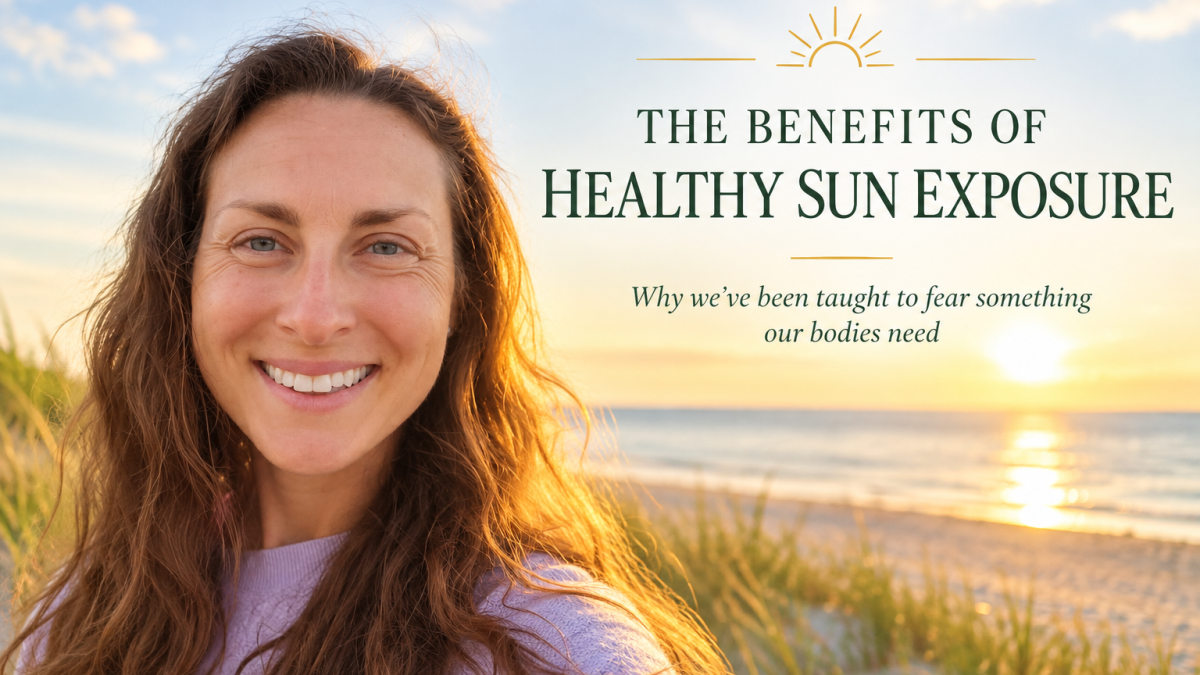
Discover the benefits of healthy sun exposure for vitamin D, circadian rhythm, sleep, mood, and reconnecting your body with natural light.
The Benefits of Healthy Sun Exposure
Why sunlight is one of the most overlooked foundations of health—and why respecting the sun is very different from fearing it.
We Were Taught to Fear the Sun
For decades, conventional health messaging has taught us to fear the sun.
Cover up. Stay out of it. Put on sunscreen before you go outside.
Protect yourself from those dangerous rays.
And yes, too much sun can burn us. I learned that lesson again myself this summer.
But somewhere along the way, protecting ourselves from too much sun became avoiding the sun altogether.
And we've lost something incredibly important in the process.
Our bodies need natural light.
We were designed to experience the changing light of morning, daytime, evening, and night—not spend our days indoors under artificial lights, staring at screens and experiencing the natural world through windows.
Light isn't simply something that allows us to see.
Light is information for the body.
Morning light tells our internal clock that the day has begun.
Sunlight helps our bodies produce vitamin D.
Natural light influences the rhythms connected with our sleep, energy, hormones, mood, metabolism, immune function, and so much more.
Our biology is deeply connected to the natural environment.
So no, my answer isn't to fear the sun.
And it isn't to lie outside for hours until my skin burns either. My recent accidental sunburn was a powerful reminder of what happens when we stop paying attention to how much exposure we're actually getting.
Respecting the sun and fearing the sun are two very different things.
We need to work with the sun.
To experience natural light regularly.
To understand what it's communicating to my body.
To enjoy its benefits while respecting its power.
Because developing a healthy relationship with sunlight isn't some fringe wellness trend.
It's about reconnecting our bodies with one of the most fundamental environmental signals humans have experienced since the beginning of time.
Sunlight Is Information for Your Body
One of the things I wish more people understood about sunlight is that it isn't only about what happens to our skin.
Light is information.
Our bodies have an internal biological clock that operates on an approximately 24-hour cycle known as our circadian rhythm.
And one of the strongest signals regulating that rhythm is light.
Your eyes detect changes in environmental light and communicate that information to the brain, helping your body understand whether it's morning, daytime, evening, or night.
That information influences far more than whether you feel sleepy.
Our circadian rhythms are connected with processes throughout the body, including sleep-wake cycles, hormone secretion, metabolism, body temperature, digestion, and immune function.
This is one of those beautiful examples of why I always say we can't divide the body into separate pieces.
Your eyes aren't operating independently from your brain.
Your brain isn't operating independently from your hormones.
Your hormones aren't operating independently from your sleep.
Your sleep isn't operating independently from your metabolism, immune system, nervous system, or digestive health.
It's all connected.
And something as simple as the light we're exposed to every day becomes part of that conversation.
Morning Light Is One of My Favorite Simple Wellness Practices
If someone asked me for one simple habit that costs nothing and can help reconnect the body with its natural rhythms, getting outside in the morning would be high on my list.
Morning light gives the brain an important signal:
The day has begun.
That daytime light exposure helps anchor our internal clock and supports the natural rhythm that eventually helps prepare us for sleep later that night.
And it doesn't have to become another elaborate wellness protocol.
Step outside while you drink your morning coffee or tea.
Take the dog for a walk. Walk your kids to the bus stop. Sit on your porch. Eat breakfast outside.
Take a few minutes to breathe before starting your workday.
We can become so focused on finding the next supplement, device, biohack, or protocol that we overlook some of the most basic signals our bodies need.
Natural light is one of them.
Daylight during the day. Darkness at night.
Our bodies understand that language.
Sunlight Helps Our Bodies Produce Vitamin D
Vitamin D is probably the benefit most people associate with sunlight—and for good reason.
When UVB rays reach exposed skin, they initiate a process that allows the body to produce vitamin D.
Vitamin D plays important roles throughout the body, including bone health, calcium metabolism, muscle function, nerve function, and immune health.
But here's where context becomes important.
The amount of vitamin D someone can produce from sunlight isn't identical from person to person.
Where you live matters. The season matters. The time of day matters. Skin pigmentation matters. Age matters. Cloud cover matters. Clothing matters. How much skin is exposed matters.
Your overall health matters.
Here in New England, for example, our relationship with sunlight changes dramatically throughout the year.
That's why I don't give everyone a rigid prescription like, "Get exactly 15 minutes of sunlight every day."
Context matters.
Your body doesn't live in a textbook. It lives in an environment.
Sunlight and Sleep Are More Connected Than Most People Realize
One of the fascinating things about circadian health is that what you do in the morning can influence what happens at night.
We often think about sleep only in terms of bedtime.
The mattress. The magnesium supplements. The blackout curtains.
Those things can matter.
But your body has been collecting information about what time it is all day long.
Getting natural light during the day—and particularly earlier in the day—provides environmental signals your circadian system uses to regulate that rhythm.
So when someone tells me they're struggling with sleep, I don't only want to know what happens at 10 PM.
I want to know what happens at 8 AM.
That's root-cause thinking.
Sometimes the clue we're looking for isn't where the symptom appears.
Sunlight Can Support Mood and Emotional Well-Being
Most of us don't need a scientific paper to tell us that being outside on a beautiful day can change how we feel.
There's something about stepping outdoors, feeling warmth on your skin, breathing fresh air, moving your body, and seeing the natural world that simply feels different from sitting inside all day.
There's biology behind some of that experience too.
Light exposure is connected with our circadian system, sleep, alertness, and mood.
But health is about more than isolating individual biochemical pathways.
Going outside often means we're doing other things our bodies benefit from.
Walking. Moving. Playing. Grounding. Gardening. Swimming. Spending time with our children. Connecting with nature. Stepping away from screens. Slowing down. Breathing.
Sometimes health happens through the accumulation of these very ordinary experiences.
Getting Outside Changes More Than Your Sun Exposure
This is one of my favorite examples of why isolating one health behavior can cause us to miss the bigger picture.
Imagine two scenarios.
In one, you spend an hour sitting inside scrolling on your phone.
In another, you spend an hour walking through the woods listening to the birds chirping.
Yes, you're getting natural light in the second scenario.
But you're also moving your body. You're experiencing nature. You're giving your nervous system a different environment. You're present in the moment.
You're giving your eyes opportunities to look into the distance rather than staring at a screen inches from your face.
You're breathing outdoor air.
You're experiencing the temperature, sounds, smells, and sensory information of the natural environment.
That's why I'm always talking about connecting the dots.
Health doesn't happen through isolated inputs.
We're constantly interacting with our environment.
Don't Forget Your Spiritual Health
There's another piece of spending time outside that doesn't get discussed nearly enough.
Our spiritual health matters too.
Especially when we're overwhelmed, touched out, exhausted, or feeling defeated by whatever life has thrown our way, one of my favorite practices to recommend is incredibly simple:
Go outside for a minute. Take a deep breath. Look up at the sky.
Notice the expansiveness around you.
Feel your feet on the ground.
Allow yourself to reconnect with something bigger than the problem sitting directly in front of you.
For me, that means connecting with the Divine and returning to a place of faith and trust—even when life feels incredibly hard.
Sometimes we need to be reminded that the moment we're experiencing isn't the entirety of our story.
If you're in one of those moments right now, I'm sending you so much love. 💗
Use this practice as often as you need it, and if you'd like more simple, down-to-earth ways to reconnect with yourself, you can also explore my free Radiant Soul Reset Series.
>>> Explore the Free Radiant Soul Reset Series
More Sun Isn't Always Better
Too much of a good thing can still have consequences.
When you're spending significant time in the sun, gradual and consistent exposure matters.
Going from very little sun exposure to spending an entire day outside in intense sun without preparation or protection can leave you with a painful sunburn. Spending prolonged periods in heat can also increase the risk of dehydration, heat exhaustion, and potentially heat stroke.
Knowing your body, paying attention to your environment, and gradually building tolerance are important.
This brings me back to a memory from years ago.
I went on a cruise in January and suddenly went from a New England winter to lying in the Caribbean sun for hours.
No gradual exposure. No real preparation. Very little protection.
I was burnt to a crisp and in pain for the rest of our vacation.
Years later, my recent Cape Cod sunburn gave me another reminder—under very different circumstances.
That experience didn't make me afraid of the sun.
It made me respect it.
You can read the entire story here:
>>> Healthy Sun Exposure: What My Sunburn Taught Me
Our Bodies Benefit From Gradual Exposure
My approach is to make natural light and outdoor time part of my life throughout the year rather than spending most of the year avoiding the sun and suddenly expecting my body to tolerate an entire summer afternoon outside.
I walk outside. I go to the beach. I spend time outdoors with my daughter. I get outside during the colder months. I expose myself to natural daylight regularly.
And when warmer weather returns, I build my sun exposure gradually.
Our bodies are incredibly adaptive.
But adaptation takes time.
That's a principle we see throughout health.
We don't become stronger by never challenging our muscles and then suddenly lifting the heaviest weight possible.
We build capacity gradually.
Our relationship with the sun deserves the same kind of respect.
The Answer Isn't to Fear the Sun
The modern conversation around sunlight has become unnecessarily polarized.
On one side, we're told to fear UV exposure and protect ourselves from the sun constantly.
On the other, we're told that eliminating seed oils, ditching sunglasses, taking the right supplement, or following the right protocol means we'll never burn.
Neither extreme reflects the bigger picture.
Sunlight is important.
Our bodies were designed to experience natural light.
Regular outdoor exposure matters.
Nutrition and overall health influence the resilience of our bodies.
And we can still get too much sun.
When I've had enough, I seek shade. I wear a hat. I cover my skin.
And when I know I'm going to have prolonged direct exposure, I personally choose a clean mineral sunscreen rather than the conventional chemical sunscreens I prefer to avoid.
That's not fear.
That's awareness.
What About Sunglasses?
This is another area where I've intentionally changed my habits over the years.
I don't put sunglasses on every time I step outside.
Why?
Because I want my eyes to experience natural environmental light.
Our eyes are one of the primary ways light information reaches the brain and influences our circadian system.
Natural outdoor light reaching my eyes isn't something I want to block every time I walk outside.
That doesn't mean sunglasses don't have a place.
I wear them while driving and there may be situations where protecting our eyes from intense UV exposure makes sense.
But automatically putting on sunglasses the moment we walk outside can also mean missing an opportunity for our eyes to experience the changing natural light environment.
Being outside in natural daylight gives your eyes access to environmental light.
What About Sunscreen?
My approach to sunscreen is similar.
I rarely use sunscreen. The few times I do, I look at the situation.
How long am I going to be outside?
What's the UV intensity?
How much exposure has my skin already had?
Can I put on a hat? Can I cover up? Can I move into the shade?
When sunscreen makes sense for prolonged exposure, I choose mineral-based products with simpler ingredients and avoid conventional chemical sunscreens because I'm intentional about reducing unnecessary chemical exposures in my life.
That's part of making an informed choice.
Protection doesn't have to mean fearing the sun.
It means understanding the situation and responding accordingly.
A Healthy Relationship With Sunlight Requires Awareness
I don't want people afraid to go outside.
I also don't want people ignoring their bodies because they heard one wellness tip that convinced them they couldn't burn.
A healthy relationship with sunlight is much more intuitive.
Get outside. Experience natural light.
Let your body know when morning has arrived.
Move outdoors. Enjoy the warmth of the sun. Build exposure gradually.
Notice how your skin responds. Know when you've had enough.
Use shade, clothing, hats, or additional protection when you need them.
Enjoy the sun. Respect the sun. Don't fear the sun.
Sunlight Is One Piece of the Bigger Picture
This is exactly why sunlight fits so naturally within The Radiant Health Method.
Our bodies aren't collections of unrelated systems.
Light influences the brain.
The brain influences hormones.
Hormones interact with sleep.
Sleep affects metabolism, immunity, mood, nervous system regulation, healing, and countless other processes.
Nutrition provides the materials our bodies need to function and repair.
Movement changes physiology.
Our environment constantly communicates with our biology.
Everything is connected.
Lasting health doesn't come from obsessing over one perfect habit.
It comes from understanding the bigger picture and creating an environment that supports the body's natural ability to function, adapt, and heal.
>>> Explore The Radiant Health Method
My Goal Is to Live in Relationship With Nature
The more I've learned about health, the more I've come back to some incredibly simple things.
Real food. Movement. Sleep. Community. Connection. Natural light. Fresh air. Time outside.
Our modern lives have made many things easier.
But they've also separated us from some of the environmental signals humans experienced naturally for generations.
The answer isn't to reject modern life.
It's to intentionally bring some of those foundations back into it.
Open the door. Step outside. Feel the temperature. Look at the sky. Walk. Breathe. Experience daylight. Watch the seasons change.
Let nature become part of your health again.
Because sometimes supporting our bodies doesn't begin with adding something new.
Sometimes it begins with reconnecting with something that was there all along.
Frequently Asked Questions
What are the benefits of healthy sun exposure?
Healthy sun exposure supports the body's natural circadian rhythm and allows the skin to produce vitamin D. Regular outdoor time can also support sleep-wake rhythms, mood, hormones, movement, and our connection with the natural environment. Sunlight is one part of a much larger foundation for health.
Is morning sunlight good for you?
Yes. Morning natural light provides an important signal to the brain that daytime has begun and helps anchor the body's circadian rhythm. Getting outside earlier in the day is one of my favorite simple wellness practices.
Does sunlight help you produce vitamin D?
Yes. UVB radiation reaching the skin initiates vitamin D production. How much an individual produces varies based on factors including season, latitude, time of day, skin pigmentation, age, clothing, cloud cover, and how much skin is exposed.
How much sunlight should I get every day?
There's no universal number that makes sense for everyone. The UV index, season, geographic location, skin pigmentation, time of day, medications, individual sensitivity, and duration of exposure all matter.
Regular outdoor time, gradual exposure, and awareness of how your own body and skin respond make far more sense to me than prescribing the exact same number of minutes to everyone.
Can sunlight help with sleep?
Natural light is one of the major environmental signals regulating our circadian rhythm. Getting daylight—especially earlier in the day—helps tell your internal clock that it's daytime, influencing the biological rhythm that eventually prepares your body for nighttime and sleep.
Should I wear sunglasses every time I'm outside?
No. I don't. I intentionally allow my eyes to experience natural outdoor light because light reaching the eyes provides important information to our circadian system.
Sunglasses still have a place when glare affects safety and when additional eye protection is appropriate. Natural daylight itself, however, isn't something I block every time I step outside.
Do I need sunscreen every time I go outside?
No. I rarely use sunscreen. If I'm going to, I consider the UV intensity, duration of exposure, my skin, clothing, available shade, and what I'm doing. When I know I'll have prolonged exposure and need additional protection, I prefer clean mineral sunscreen along with hats, clothing, and shade.
Can you still get sunburned if you regularly spend time outside?
Absolutely.
Gradual exposure can help the skin adapt to increasing sun exposure, but it doesn't make anyone immune to excessive UV exposure. My own Cape Cod sunburn was a perfect reminder of that.
Continue Your Radiant Health Journey
Every article is designed to help you better understand your body, connect the dots, and discover what deserves your attention first.
Sunlight is one of those pieces—but like everything in health, it makes the most sense when we understand how it fits into the bigger picture.
Healthy Sun Exposure: What My Sunburn Taught Me
Read what happened when I accidentally fell asleep at the beach on a cool, cloudy day—and why the experience strengthened rather than changed my philosophy about sunlight.
>>> Read Healthy Sun Exposure: What My Sunburn Taught Me
How I Supported My Skin After a Sunburn Naturally
Learn how I supported my skin and body after that unexpected sunburn using aloe, tallow, hydration, electrolytes, nutrient-dense foods, rest, and recovery.
>>> Read How I Supported My Skin After a Sunburn Naturally
How to Build a Healthier Relationship With Sunlight
Explore morning light, regular outdoor time, gradual sun exposure, protection when needed, and reconnecting our bodies with natural rhythms.
>>> Read How to Build a Healthier Relationship With Sunlight
Hydration: More Than Just Drinking Water
Discover why hydration involves much more than simply drinking more water and why minerals and electrolyte balance matter too.
>>> Read Hydration: More Than Just Drinking Water
The Radiant Health Method
Discover how nutrition, lifestyle, nervous system health, environment, emotional health, and other factors work together—and why lasting healing requires us to connect the dots.
>>> Explore The Radiant Health Method
💖 Dr. Beata "Your Body Wants to Heal" Harasim
Categories: : Autumn Wellness, Energy & Vitality, Family Wellness, Healthy Living, Holistic Health, Integrative Medicine, Lifestyle & Wellness, Radiant Health Method, Sleep & Recovery, Spring Wellness, Summer Wellness, Winter Wellness