How I Supported My Skin After a Sunburn Naturally
 Dr. Beata Harasim
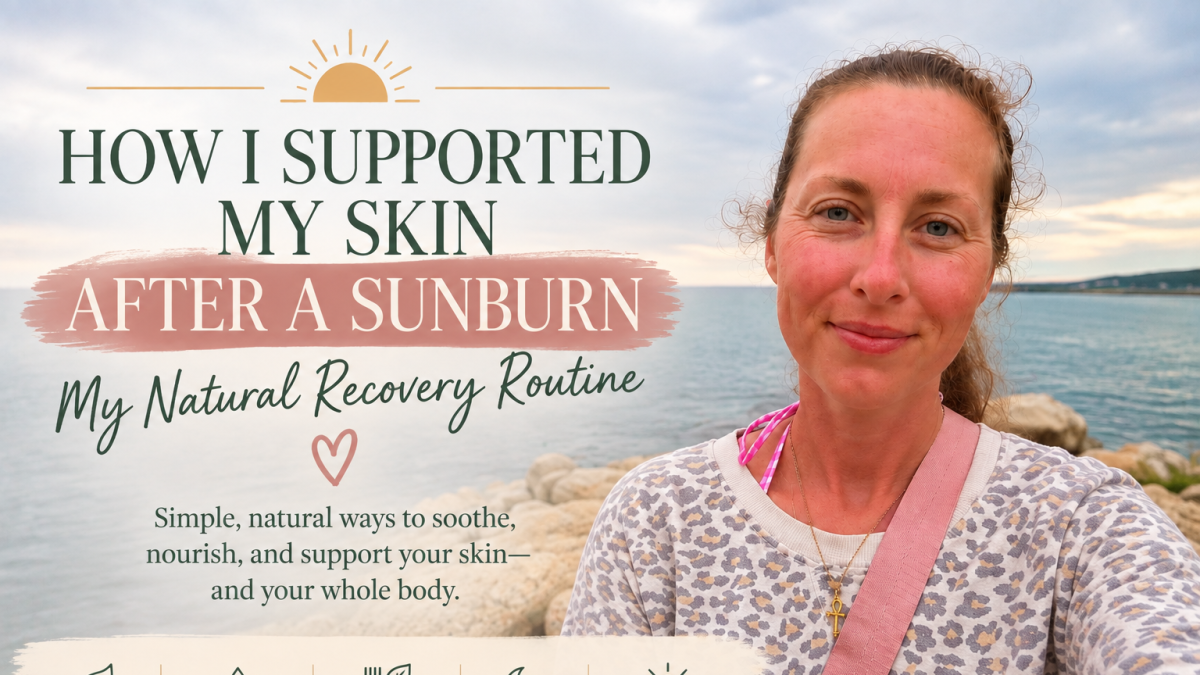
See how I supported my skin after an unexpected sunburn using fresh aloe, tallow, hydration, nourishment, rest, and whole-body recovery.
How I Supported My Skin After a Sunburn Naturally
What I did after my first sunburn in years- and the everyday foundations that helped my body recover so quickly.
I hadn't had a real sunburn in years.
And then I accidentally fell asleep on a beach in Cape Cod. For hours. 😂
It wasn't even the kind of day you'd expect to get badly burned.
It was cool. Cloudy. Windy.
I had been wearing a sweatshirt. I had a hat. My legs were under a towel much of the time.
I was journaling, meditating, doing some emotional healing work...
and apparently got a little too relaxed.
Because I fell asleep.
By the time I realized how much sun I'd actually gotten, my face—especially my cheeks—was significantly burned.
If you want to hear the whole story of how I accidentally got my first sunburn in years, you can read that here:
>>> Healthy Sun Exposure: What My Sunburn Taught Me
But this article is about what happened afterward.
Because my skin recovered remarkably quickly.
And whenever something like this happens, I'm interested in more than:
What can I put on it?
That's one piece.
But my skin isn't separate from the rest of my body.
So I wasn't only thinking about aloe.
I was thinking about hydration. Minerals. Nutrition. Recovery. My skin barrier. Further sun exposure.
And all of the things I had already been doing for years that support my body long before something goes wrong.
I don't think healing begins when we reach for a remedy.
The foundation we create every day matters too.
And I think that's an important part of this story.
I don't eat seed oils.
I get natural light in my eyes throughout the year.
I rarely wear sunglasses.
I expose my skin to sunlight gradually as the seasons change.
I eat nutrient-dense real food.
I pay attention to hydration and minerals.
I prioritize sleep and recovery.
Do I think those things contributed to the resilience of my skin and how well my body recovered?
Yes.
Do I think any one of them makes me incapable of getting a sunburn?
Clearly not. 😂
I fell asleep for hours and exceeded what my skin could handle.
Supporting your body's natural resilience doesn't make you invincible.
It gives your body a stronger foundation to work from when life happens.
Here's what I did.
The First Thing I Did Was Respect the Burn
I love the sun.
And getting sunburned didn't suddenly make me afraid of it.
But loving sunlight doesn't mean ignoring what my body is telling me.
My skin had received more ultraviolet radiation than it could handle.
So once I realized I was burned, I wasn't trying to get more sun.
I protected the irritated areas from additional exposure and gave my skin time to recover.
That's an important distinction in the way I approach sunlight.
Enjoy the sun. Respect the sun. Don't fear the sun.
Respecting the sun means recognizing when you've had enough.
I Used Fresh Aloe Vera Straight From the Plant
The first thing I reached for was one of the simplest remedies I have:
fresh aloe vera.
Not aloe gel from a bottle.
The actual plant.
I grow aloe, harvest the clear inner gel, and freeze it in small ice-cube-sized portions so I always have some ready when I need it.
And let me tell you...
cold fresh aloe on hot sunburned skin feels incredible.
I take out a small portion, allow it to soften enough that I'm not rubbing a rock-hard frozen cube over irritated skin, and apply the gel.
Cooling. Soothing. Simple.
No artificial color. No fragrance. No long ingredient list.
Just aloe.
This is one of those little things I love about natural health.
We can become so accustomed to believing that every problem requires another product that we forget how useful some of the simplest things can be.
How I Prepare Fresh Aloe to Keep in My Freezer
I harvest an aloe leaf and separate the clear inner gel from the outer leaf and yellow latex layer.
Then I portion the clear gel into an ice cube tray and freeze it.
Once it's frozen, I can transfer the portions into a freezer-safe container and take out a little at a time.
A little goes a long way.
And because everyone's skin is different, if you've never used fresh aloe topically before, try a small area first.
I Used Tallow as My Skin Became Dry
The aloe was wonderful when my skin felt hot and irritated.
Later, I reached for something different: Grass-Fed Beef Tallow Balm.
As the heat settled and my skin began feeling dry and tight, I wanted something simple and nourishing to moisturize it.
That's where tallow balm came in.
I already use traditional, simple skincare ingredients, so this wasn't something new I bought because I had a sunburn.
It was already part of my routine.
And that's an important theme throughout this entire experience.
I wasn't scrambling to create health after something went wrong.
I was leaning on foundations I already had.
I don't look at tallow as something that magically reverses UV damage.
My skin was doing the repair.
I was giving it a supportive environment while it did.
>>> Shop the Tallow Balm I Use
I Hydrated—and Thought About Minerals Too
I also supported my body from the inside.
I drank water.
But hydration isn't just about pouring more plain water into the body.
Minerals matter too.
When we're spending hours outside, sweating, swimming, walking through sand, and being active in the heat, we're losing fluid and electrolytes.
So I paid attention to both.
Water. Minerals. Electrolytes.
No, an electrolyte packet isn't a “sunburn cure.”
That's missing the bigger point.
The skin doing the healing belongs to an entire body.
Supporting that body matters.
That doesn't mean everyone needs an electrolyte packet in every glass of water they drink.
Context matters.
Hours outside in the heat, sweating, healing a sunburn, swimming, walking through sand, and playing are very different from sitting indoors in air conditioning.
What your body needs depends on your individual needs, diet, activity, environment, health history, and other factors.
For me, having convenient electrolyte packets available can be useful on long, active days outside- but they're a tool, not something I believe everyone automatically needs.
>>> Read: Hydration Is More Than Just Drinking Water
I Continued Nourishing My Body
I didn't suddenly start eating a special “sunburn diet.”
I continued eating the way I normally eat.
Real food. Quality protein. Nutrient-dense foods. Traditional fats.
Foods that provide the raw materials my body uses every day.
Our skin doesn't exist in a vacuum.
Protein provides amino acids used throughout tissue repair.
Fats are structural components of our cells.
Vitamins and minerals participate in countless processes involved in normal cellular function and repair.
This is one of the reasons I care so deeply about nutrition.
You don't start building health the day something goes wrong.
You're building it every day.
And when something does happen, your body has whatever foundation you've given it to work with.
>>> Download My Free Real Food Guide
I Gave My Body Time to Recover
Then there's one of the most overlooked pieces of healing:
Rest.
We live in a culture that is constantly on the go and doing more.
Sometimes what the body needs is an opportunity to do the work it already knows how to do.
Sleep. Rest. Less stress. Time.
I didn't spend days lying in bed because I had a sunburn.
But I respected the fact that my body was recovering.
I didn't see recovery as wasted time. Recovery is part of healing.
>>> Read: Recovery Is Where Healing Happens
I Didn't Attack My Skin While It Was Trying to Repair
No scrubbing. No aggressive exfoliation. No picking at peeling skin. No complicated skincare routine. No ten-product sunburn protocol.
My skin was irritated. So I treated it like irritated skin.
Simple. Gentle. Supportive.
Sometimes we interfere with healing because we're so desperate to do something.
More isn't always better.
That applies to supplements. It applies to protocols. And it applies to skincare.
But My Sunburn Recovery Didn't Start That Day
This is the piece that gets missed in most articles about sunburn.
They begin when the skin turns red.
That's not where the story begins.
Your skin is living tissue.
It's connected to your nutrition, your environment, your circadian biology, your stress physiology, your sleep, and the rest of you.
And there are things I do throughout the entire year that helped create the foundation my body had available when I got burned.
I Let My Body Experience Natural Light Year-Round
One of the most fundamental things I do is also one of the simplest.
I go outside.
Not just in July. All year.
Our bodies evolved in relationship with changing natural light.
Natural light isn't just illumination.
Light is information.
Light entering our eyes is one of the primary signals our brain uses to set our circadian clock—the internal timing system influencing sleep, wakefulness, hormone rhythms, metabolism, and countless processes throughout the body.
Our skin responds to light too.
Melanocytes respond to light by producing pigment, and melanin is part of our body's natural response to the solar environment.
The more we learn about light biology, the clearer it becomes to me that our relationship with sunlight is far more sophisticated than expected and a vital part of our health and vitality.
I Let Natural Light Reach My Eyes
I intentionally allow natural outdoor light into my eyes.
I don't automatically put sunglasses on every time I walk outside.
I want my brain receiving the natural light signals that tell it:
This is morning. This is daytime. This is evening.
That light information helps synchronize our biology with the environment around us.
And there is fascinating emerging research into communication between light exposure, the eyes, neuroendocrine signaling, and melanocyte biology.
Our eyes are part of how our bodies sense the light environment.
Personally, I generally reserve sunglasses for situations where I need them—especially driving, strong glare, or visual safety.
I'm also not talking about staring directly into the sun.
I'm talking about something much simpler:
going outside and allowing your body to experience natural daylight.
I Build My Sun Exposure Gradually
I don't spend nine months hiding indoors and then expect my skin to handle eight hours of intense summer sun.
As spring arrives and the days become longer and stronger, I'm outside.
My exposure naturally increases with the season.
Our bodies adapt to their environment.
Melanin production is one of the ways skin responds to light exposure.
That's why gradual exposure makes so much more sense to me than an all-or-nothing relationship with sunlight.
And this is also why my Cape Cod sunburn was such a good reminder.
I had been getting regular sun.
My skin was accustomed to sunlight.
I still burned.
Why?
Because I fell asleep for hours. 😂
Adaptation doesn't mean unlimited tolerance.
Dose still matters. Duration still matters. Time of day still matters. Your individual skin still matters.
The body can adapt beautifully—and you can still overwhelm its capacity.
Those two truths can exist together.
I Don't Eat Industrial Seed Oils
Nutrition is another piece of my approach.
I haven't eaten industrial seed oils in years.
I choose traditional fats and nutrient-dense whole foods instead.
Why does that belong in a conversation about skin?
Because the fats we eat become part of our biology.
Polyunsaturated fatty acids are incorporated into cellular membranes, and highly unsaturated fats are more susceptible to lipid peroxidation.
UV exposure itself creates oxidative stress in the skin.
That's one reason the relationship between dietary fatty acids, oxidative stress, and the skin's response to UV exposure is such an interesting area to me.
There are people in the natural-health world who will take that several steps further and tell you:
Stop eating seed oils and you won't sunburn.
I wouldn't say that.
Because that's obviously not what happened to me.
I haven't eaten seed oils in years—and I still burned.
What I will say is that I care about the fats I use to build my cells.
That matters for overall cellular health and resilience.
The relationship between dietary fats and UV response deserves a much deeper conversation than either “seed oils cause sunburn” or “diet has nothing to do with it.”
I explore that exactly in this article.
>>> Read: Can Seed Oils Really Make You Burn More Easily?
And Yes, You Still Make Vitamin D From the Sun
There's another reason I don't fear my relationship with sunlight.
Our skin can make vitamin D from sunlight.
When UVB reaches the skin, it initiates the conversion of 7-dehydrocholesterol toward vitamin D3.
Think about that for a moment.
Our bodies have a biological pathway specifically designed to interact with sunlight.
That doesn't mean more UV is always better. It doesn't mean burning is healthy.
It means sunlight and human biology have a relationship.
Sunburn isn't the goal.
Healthy interaction with our natural environment is.
That's why my philosophy remains:
Enjoy the sun. Respect the sun. Don't fear the sun.
>>> Read: The Benefits of Healthy Sun Exposure
None of These Things Made Me Invincible
This may be my favorite part of the entire story.
I do all the things. And...
I still got sunburned.
I don't see that as evidence that these foundations don't matter.
I see it as evidence that health isn't about finding one rule that makes you invincible.
Your body has an incredible ability to adapt. But it also has limits.
That day, I exceeded mine.
And my skin told me very clearly.
Why Did My Skin Recover So Quickly?
Because I didn't start supporting my body when I saw the sunburn.
I had been supporting it all along.
Did the fresh aloe help soothe my skin?
Absolutely.
Did the tallow balm help keep it moisturized?
Yes.
Did hydration matter?
Of course.
Did sleep and recovery matter?
They did.
And did years of nutrient-dense eating, avoiding seed oils, regular outdoor light exposure, gradual sun exposure, and supporting my health as a whole gave my body a better foundation from which to recover?
Yes.
Can I tell you which one was responsible for exactly 17% of my recovery?
Of course not.
And I don't need to.
That's not how bodies work.
Health is rarely about one thing.
This is exactly why I'm always talking about connecting the dots.
Healing Isn't About Finding the Miracle Product
This experience reinforces one of the foundational principles behind The Radiant Health Method:
Your body wants to heal.
Your body is constantly responding.
Adapting. Repairing. Regulating.
Healing doesn't always require us to micromanage every one of those processes.
Sometimes our role is to remove what is interfering and provide what the body needs.
For my skin, that looked like:
Cooling. Moisture. Hydration. Minerals. Nourishment. Rest. Protection from additional excessive UV exposure.
And time.
Fresh aloe wasn't the hero. Tallow wasn't the hero. Neither were electrolytes.
My body was doing the healing.
Those things simply helped create an environment that supported it.
And that principle reaches far beyond a sunburn.
When a Sunburn Needs More Support
Natural support doesn't mean ignoring a serious burn.
A mild sunburn and a severe UV injury are very different situations.
Significant or widespread blistering, severe swelling or pain, fever, chills, nausea, confusion, faintness, dehydration, signs of infection, eye symptoms, or feeling systemically unwell deserve medical attention.
And don't intentionally pop sunburn blisters. They help protect the damaged skin underneath while it heals.
Symptoms are information.
Listen to what your body is communicating.
Frequently Asked Questions
What can you put on a sunburn naturally?
I keep it simple. I personally use fresh aloe vera from the plant for its cooling, soothing effect and tallow balm later when my skin feels dry and tight. I also think beyond topical products and support hydration, nutrition, sleep, and recovery.
Can you use fresh aloe vera straight from the plant on a sunburn?
That's exactly what I do. I harvest the clear inner aloe gel, separate it from the yellow latex layer, freeze it in small portions, and use a little when I need something cooling and soothing.
Can you freeze fresh aloe vera for sunburn?
Yes. I portion my fresh aloe gel into an ice cube tray and freeze it. I let a portion soften before applying it rather than rubbing a hard frozen cube over irritated skin.
Can you put tallow balm on a sunburn?
I personally use tallow balm once the initial heat has settled and my skin begins feeling dry or tight. I use it as a simple moisturizer while my skin recovers, not as something that magically reverses UV damage.
Does gradual sun exposure help prevent sunburn?
Yes, gradual exposure is an important part of developing a healthier relationship with sunlight because skin responds and adapts to its light environment. But adaptation doesn't create unlimited UV tolerance. I gradually expose my skin and still got burned when I accidentally stayed in the sun for hours.
Does natural light in your eyes affect your body?
Absolutely. Light entering the eyes is one of the primary environmental signals regulating our circadian clock and helping synchronize our biology with the natural day-night cycle. That's why natural outdoor light is a foundational part of my health routine.
Do seed oils make you burn more easily?
There is a biologically interesting relationship between dietary fats, lipid peroxidation, oxidative stress, and UV exposure, but the claim that eliminating seed oils will prevent sunburn goes beyond what we currently know. I personally haven't eaten industrial seed oils in years because of the bigger picture of how I choose to nourish my body—and I still managed to burn when my UV exposure was excessive.
Does drinking water help a sunburn?
Water doesn't reverse UV injury. But your skin is healing as part of an entire body, and maintaining adequate hydration is one of the foundations I prioritize during recovery.
Should you avoid the sun completely after a sunburn?
I protect burned skin from additional UV exposure while it's recovering. That doesn't mean I've become afraid of sunlight. It means I listen when my body tells me it has had enough.
Continue Your Radiant Health Journey
Every article is designed to help you better understand your body, connect the dots, and discover what deserves your attention first.
Healthy Sun Exposure: What My Sunburn Taught Me
Want to know how someone who hadn't had a real sunburn in years accidentally got one on a cool, overcast Cape Cod day? This is the full story.
>>> Read Healthy Sun Exposure: What My Sunburn Taught Me
The Benefits of Healthy Sun Exposure
We've spent decades hearing about the dangers of sunlight. But natural light is also one of the fundamental environmental signals our bodies need.
>>> Read The Benefits of Healthy Sun Exposure
My Favorite Beach Essentials for a Healthier Day in the Sun
See the things that have actually earned a place in my beach wagon—from shade and hydration to real food and the gear that makes beach days easier.
>>> Read My Favorite Beach Essentials
Recovery Is Where Healing Happens
Healing isn't only about what we add. Our bodies also need opportunities to repair, regulate, and recover.
>>> Read Recovery Is Where Healing Happens
Why Eating Healthy Isn't Always Enough to Heal
Nutrition matters tremendously. But your health is the result of an interconnected system—not one food, one supplement, or one protocol.
>>> Read Why Eating Healthy Isn't Always Enough to Heal
💖 Dr. Beata "Radiant Health" Harasim
Categories: : Eczema & Skin Health, Family Wellness, Healthy Living, Holistic Healing, Holistic Health, Lifestyle & Wellness, Root Cause Healing, Seasonal Health, Summer Wellness