What’s in a Pumpkin Spice Latte? Ingredients + Clean Recipe | Dr. Beata
 Dr. Beata Harasim

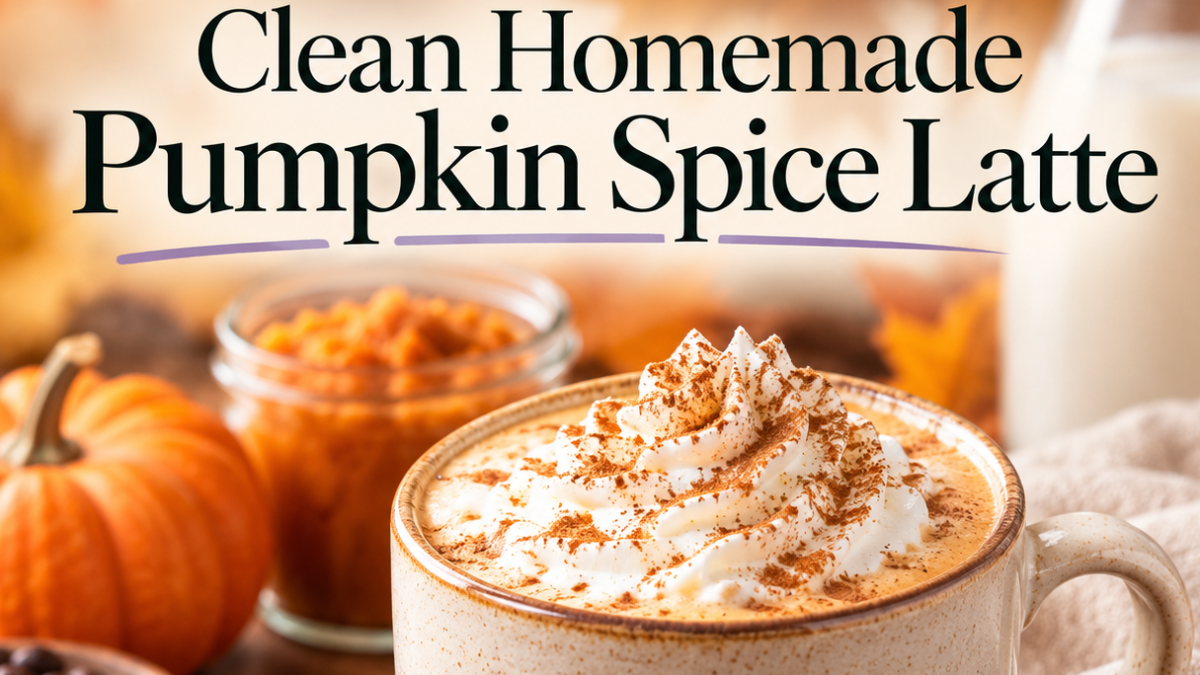
What’s actually in your pumpkin spice latte? Look beyond calories at sugar, flavors and additives—plus make a clean homemade pumpkin spice latte.
What’s Actually in Your Pumpkin Spice Latte? Why Ingredients Matter More Than Calories
There’s something about the first cool fall day and the return of pumpkin spice everything.
Coffee shops bring back their seasonal drinks. Grocery-store shelves fill with pumpkin-flavored creamers, syrups, snacks and desserts. And suddenly that familiar pumpkin spice latte starts sounding pretty good again.
I get it. I love the flavors of fall too.
But when I look at a pumpkin spice latte, the first thing I’m interested in isn’t the calorie count.
I want to know what’s actually in it.
Because your body doesn’t simply count calories, carbohydrates, fat and protein. It has to interact with the ingredients those calories came from.
And that’s a conversation I think we need to be having much more often.
We’ve Been Taught to Look at Nutrition Facts—But What About the Ingredients?
For decades, much of the nutrition conversation has revolved around numbers.
How many calories does it have? How much fat? How many carbohydrates? How much protein?
Macros and calories can provide useful information, but they don’t tell you the entire story of a food.
Two drinks can have a similar number of calories while being made from very different ingredients.
One might be prepared at home with quality coffee, pure milk or homemade nut milk, real pumpkin, organic spices and a little maple syrup or honey. Another may contain substantial added sugar along with flavored sauces, preservatives, stabilizers, emulsifiers or other highly processed ingredients, depending on the product and how it’s prepared.
The ingredient list tells you something the calorie count can’t: what you’re actually putting into your body.
That’s why I look at both.
So What’s Actually in a Pumpkin Spice Latte?
There isn’t one universal pumpkin spice latte recipe.
The ingredients can vary considerably depending on the coffee shop, brand, size, milk choice, flavored sauce, whipped topping and any customizations you make. Packaged pumpkin-spice creamers and ready-to-drink versions can have completely different formulations again.
This is about knowing what you’re drinking.
A sweet seasonal coffee can quickly become a significant source of added sugar, while the sauces, syrups, creamers and toppings used to create that familiar flavor may contain ingredients you wouldn’t want to put into a homemade version or in your body in general.
That can include natural flavors, preservatives, emulsifiers, stabilizers, colors and other additives, depending on the product.
And some of those words deserve a closer look.
What Does “Natural Flavor” Actually Mean?
“Natural flavor” is one of those phrases that sounds far more wholesome than it actually is.
Most people see the word natural and imagine that the flavor came from something recognizable—vanilla beans, cinnamon, fruit, herbs or spices.
But a “natural flavor” can be a highly processed formulation that looks nothing like the ingredient it originally came from.
Under FDA regulations, natural flavors can originate from a broad range of plant and animal sources. Manufacturers can then use extraction, fermentation, heating and other processing methods to isolate or produce the compounds they want for flavor.
And this is where I think consumers deserve to know more.
The flavor industry even lists preparations produced by fermenting corn syrup with bacteria, creating mixtures containing glutamic acid, amino acids, alcohols, aldehydes, acids, esters and other compounds.
That's not what most people picture when they see natural flavor on the side of their pumpkin spice creamer.
And our modern food supply contains ingredients from some pretty unexpected sources. What makes this even more interesting is how broad the term “natural flavor” actually is.
A natural flavor doesn't necessarily come from the food you think you're tasting. Under FDA regulations, natural flavors can be derived from fruits and vegetables, but also from bark, roots, leaves, edible yeast, dairy, eggs, meat, seafood and other animal products, as well as fermentation products. Those starting materials can then be extracted, distilled, heated, enzymatically processed or fermented to produce the particular flavor compounds a manufacturer wants.1
Some modern flavor ingredients are even produced through microbial fermentation. A substance may begin with something like corn-derived sugar, undergo fermentation with microorganisms and ultimately become a mixture of compounds used for flavor. By the time it reaches the finished food, we're a long way from the recognizable whole-food ingredient most people picture when they read the word natural.2
And the label doesn't necessarily have to tell you what each of those flavoring substances is. FDA regulations allow qualifying flavor ingredients to be grouped together under the words “natural flavor.”2
That's what bothers me about the term.
If you see pumpkin, cinnamon, ginger and nutmeg on a label, you know what is creating the flavor. If you see “natural flavors,” you don't necessarily know the original source, the individual flavoring compounds or how extensively those ingredients were processed before they reached your food.
That's a very different level of transparency.
And it's one more reason I would rather make my pumpkin spice latte with actual organic pumpkin and organic spices than rely on a proprietary flavoring system to make something taste like pumpkin and spice.
This is one of the biggest reasons I want people reading labels.
My standard for food isn't simply, Is this ingredient legally allowed in our food supply?
I want to know: What is it? Where did it come from? How was it made? And is this something I actually want to put into my body?
Because there is an enormous difference between eating cinnamon and consuming a manufactured flavoring formulation that began with a “natural” source.
Our bodies have sophisticated systems for breaking down, metabolizing and eliminating compounds we encounter. And biologically, every novel, isolated or highly processed compound we can manufacture for the modern food supply is not equivalent to eating real food—or something I want my body continually tasked with handling.
What we're putting into our bodies matters.
That's the piece that gets lost when the conversation stops at, “It's FDA approved.”
I don't want my food engineered to taste like cinnamon when I can use cinnamon.
I don't need a proprietary pumpkin flavoring system when I can use actual pumpkin, ginger, cloves and nutmeg.
And I don't consider “natural flavor” meaningful transparency when the label still doesn't tell me what I'm actually consuming.
If it's going into my body, I want to know what's in it.
That's why my homemade pumpkin spice latte tastes like pumpkin spice because it contains real pumpkin and real organic spices.
No mystery flavoring system required.
And “Citric Acid” Isn't Coming From Lemons
Citric acid is another example of why I want people to look beyond an ingredient's familiar-sounding name and understand how modern food ingredients are actually made.
When you hear citric acid, you probably picture lemons, limes and oranges. And yes, citric acid occurs naturally in citrus fruit.
But that's generally not where the citric acid added to processed foods comes from.
Most commercially produced citric acid is made through microbial fermentation, with Aspergillus niger—a species commonly known as black mold—serving as the primary microorganism used for large-scale production.3
And here's another piece many consumers don't realize: the carbohydrate used to feed that fermentation can come from corn.
Corn and corn-derived starches are established substrates for producing citric acid with Aspergillus niger. In fact, an entire scientific review has examined industrial approaches beginning with whole maize flour or isolated maize starch. Other sugars and carbohydrate sources can also be used, so this doesn't mean every container of citric acid came from corn—but the ingredient label generally doesn't tell you which fermentation substrate was used.4
So an ingredient called “citric acid” may have been produced through a process in which Aspergillus niger is grown on sugars or starches—including corn-derived substrates—and metabolically produces citric acid. The resulting citric acid is then separated and purified from the fermentation mixture.5
That's a very different process from squeezing lemons.
And it's exactly why you don't assume you understand an ingredient simply because its name sounds familiar.
The name on the ingredient list doesn't necessarily tell you what it was made from, what organism was used to manufacture it or how extensively it was processed before it reached your food.
I want to know where my food comes from and how it was made.
If I want citric acid from citrus, I'd rather get it from actual lemons and limes. If I want pumpkin spice flavor, I'd rather use actual pumpkin, cinnamon, ginger, nutmeg and cloves.
That's what eating real food means to me.
Sugar Matters—and Many Coffee-Shop Drinks Are Loaded With It
When we're talking about what's actually in a pumpkin spice latte, we absolutely need to talk about the sugar.
Many coffee-shop drinks contain an enormous amount.
As one example, a current Grande 16-ounce Starbucks Iced Pumpkin Spice Latte contains 45 grams of total sugar—roughly 11 teaspoons.6 That's more total sugar than the roughly 42 grams of added sugar the CDC uses as its example for an entire 12-ounce can of soda.
And this isn't something I brush aside simply because it's a seasonal treat.
How much sugar we consume matters.
Research has linked higher sugar consumption—particularly sugar-sweetened beverages and diets high in added sugars—with a wide range of adverse health outcomes. A large umbrella review evaluating 73 meta-analyses and 83 health outcomes found significant harmful associations between dietary sugar consumption and numerous endocrine and metabolic, cardiovascular, cancer and other health outcomes.7
We have especially strong reasons to pay attention when it comes to metabolic health. Regularly consuming large amounts of added sugar can contribute to excess calorie intake and weight gain, and high consumption of sugar-sweetened beverages has been associated with metabolic syndrome and type 2 diabetes. The CDC specifically identifies excessive added-sugar intake as contributing to weight gain, obesity, type 2 diabetes and heart disease.8
Sugar also intersects with immune and inflammatory biology. Glucose and fructose participate in immune-cell metabolism and can influence inflammatory and immune pathways, although the effects depend on the amount, dietary context and metabolic state.9
So no, I don't consider 40-plus grams of sugar in one coffee an insignificant detail.
And this is one of the biggest advantages of making your pumpkin spice latte at home.
You control the sweetness.
You don't need four pumps of a pre-made pumpkin sauce to make something taste like fall. You can start with a small amount of a sweetener such as raw honey or pure maple syrup, taste it, and decide whether you even need more.
Raw honey and maple syrup are still sources of added sugar—your body doesn't give them a free pass simply because they're natural. But when I have a choice, I prefer recognizable, minimally processed sweeteners over highly refined syrups, and I can use considerably less when I'm making the drink myself.
And I don't solve the problem by automatically reaching for a chemically synthesized “zero-calorie” artificial sweetener, either.
Saccharin, aspartame, acesulfame potassium, sucralose, neotame and advantame are chemically synthesized artificial sweeteners approved for use in foods in the United States.10 But “approved” doesn't mean there are no questions about their long-term effects.
The World Health Organization recommends against using non-sugar sweeteners as a strategy for long-term weight control or reducing the risk of chronic disease, following its systematic review of the available evidence.11
And a 2026 systematic review and meta-analysis including more than 3.6 million participants found that higher artificial-sweetener intake was associated with increased risks of type 2 diabetes, hypertension, heart failure, stroke, coronary artery disease, cardiovascular mortality and all-cause mortality.12
These findings certainly challenge the assumption that replacing sugar with a chemically synthesized zero-calorie sweetener automatically makes something a healthier choice.
We’ve been conditioned to expect more and more sweetness—and we can break that pattern. When you make your pumpkin spice latte at home, you decide how sweet it needs to be. Use less, let your palate adjust, and rediscover what real coffee, pumpkin and spices actually taste like.
Real coffee. Real pumpkin. Organic cinnamon, ginger, nutmeg and cloves. Your milk of choice. And, if you want sweetness, a small amount of a real-food sweetener that you control. (Scroll down for the recipe)
That's another reason I love making foods like this at home.
You aren't stuck with someone else's recipe—or someone else's idea of how much sugar your body needs.
Your Gut Doesn’t Exist in Its Own Little Box
This is where the conversation becomes much bigger than whether a pumpkin spice latte makes you bloated.
Your digestive system is connected to the rest of your body.
Research now describes a complex, bidirectional brain-gut-microbiome system in which the gut, brain and gut microbes communicate through neural, endocrine and immune pathways. The brain can also influence gastrointestinal motility, secretion and permeability.13
That means nutrition matters beyond digestion because the digestive system itself doesn’t operate in isolation.
Food provides raw materials our bodies use every day, while our overall dietary patterns also help shape the intestinal environment.
That’s why when someone comes to me struggling with digestive problems, food reactions, skin issues, fatigue, brain fog or other chronic symptoms, I want to know what they’re eating.
Because it’s one of the most important pieces.
What About Food Dyes and Children’s Behavior?
What our children eat matters for their developing bodies and their brains.
Synthetic food dyes are a good example. A 2022 systematic review examining human and animal evidence found that the human clinical literature supports a relationship between synthetic food-dye exposure and adverse behavioral outcomes in some children, particularly changes in activity and attention.¹⁴
That's not something I think we should dismiss.
When a parent repeatedly notices that their child becomes more hyperactive, impulsive, emotionally reactive or has a harder time focusing after certain foods, I want to know more. Parents know their children, and when the same pattern keeps showing up, it's a clue worth investigating.
And food dyes may only be one piece of that investigation.
I want to understand what the child is eating overall, which foods or ingredients seem to correspond with changes, how frequently they're being consumed and what else is happening in the child's body. Digestion, gut health and the microbiome all belong in that investigation, along with individual foods and food components, ingredients and additives, the degree of processing, sleep, stress and other pieces of the child's health story.
Behavior doesn't happen separately from the body.
That's one of the reasons I don't want parents simply being handed a list of foods to remove. The bigger question is what the patterns are telling us about that particular child—and then how we translate what we're learning into food choices that are actually realistic for the family.
Because knowing what you don't want your child eating is one thing.
Figuring out what to actually feed them—especially when they're picky, sensitive to textures, have food allergies or tolerate a limited number of foods—can be an entirely different challenge.
If you're seeing patterns between food and your child's digestion, mood, attention, energy or behavior and you're struggling to connect the dots, that's something we can explore in a Root Cause Clarity Session. We look at the bigger picture of their symptoms, history, diet and patterns and help clarify what deserves your attention now—including practical considerations around what you're actually going to feed them.
And these sessions aren't only for children. The same principle applies to adults: when you repeatedly notice that certain foods, ingredients or eating patterns correspond with changes in how you feel or function, your body is giving you information worth paying attention to.
What We Feed Our Children Matters—and So Does What We Feed Ourselves
Food doesn't only matter when someone has a digestive complaint.
What we eat becomes part of the environment our bodies have to function within every single day. Food provides the protein, fats, carbohydrates, vitamins, minerals and other compounds our bodies use to build, repair, communicate and create energy. At the same time, the foods and ingredients we consume interact with our digestive system, gut microbiome, immune system, metabolism and nervous system.
That's why when someone is struggling with their health, I want to know what they're eating.
Maybe the clues are showing up as bloating, constipation, reflux or other digestive symptoms. But they may also be showing up through changes in energy, skin, sleep, mood, attention, cognition, immune function, blood-sugar regulation or the way someone feels after eating particular foods.
And this matters whether someone has an official diagnosis or not.
If someone has eczema, migraines, an autoimmune condition, metabolic dysfunction, anxiety, ADHD or another diagnosed condition, I'm still interested in the patterns surrounding food. I'm interested in whether certain symptoms change after particular foods or ingredients, whether someone's diet is providing the nutrients their body needs, how well they're digesting and absorbing those nutrients, what their overall dietary pattern looks like and whether highly processed foods and additives are making up a significant part of what they're consuming.
Food is one of the fundamental inputs the body receives every day, so it deserves a place in the investigation.
And sometimes the clues are surprisingly specific. Someone may notice their skin consistently flares after a certain food, their energy crashes after particular meals, their digestion changes when they eat differently, or their brain feels clearer when certain ingredients aren't part of their everyday diet.
Those patterns matter.
Your body is constantly responding to what you're giving it. Paying attention to those responses can help you begin connecting dots that might otherwise be missed.
That's why I'm interested in what you're putting into your body consistently, how your body is responding, and what patterns emerge over time.
Because what we feed ourselves matters. What we feed our children matters.
And the more we understand about what's actually in our food and how our individual bodies respond to it, the more informed our choices can become.
If you're seeing patterns between food and your symptoms and you're struggling to connect the dots, that's something we can explore in a Root Cause Clarity Session. We look at your symptoms, history, diet and patterns and help clarify what deserves your attention now for your next step.
Start Getting Curious About What’s Actually in Your Food
The next time you pick up a seasonal drink, packaged snack or even a food you’ve purchased for years, turn it around and look at the ingredient list.
Notice what’s actually in it, how often you’re consuming it and, importantly, how you feel when you do.
Read the labels. Pay attention to your symptoms. Start noticing the patterns.
Because your symptoms are clues, and your body is giving you information all the time.
The more aware you become of what you’re putting into your body, the more empowered you become to make choices that support it.
And that brings me back to pumpkin spice lattes.
Because no, you don’t have to give up pumpkin spice season. 🎃
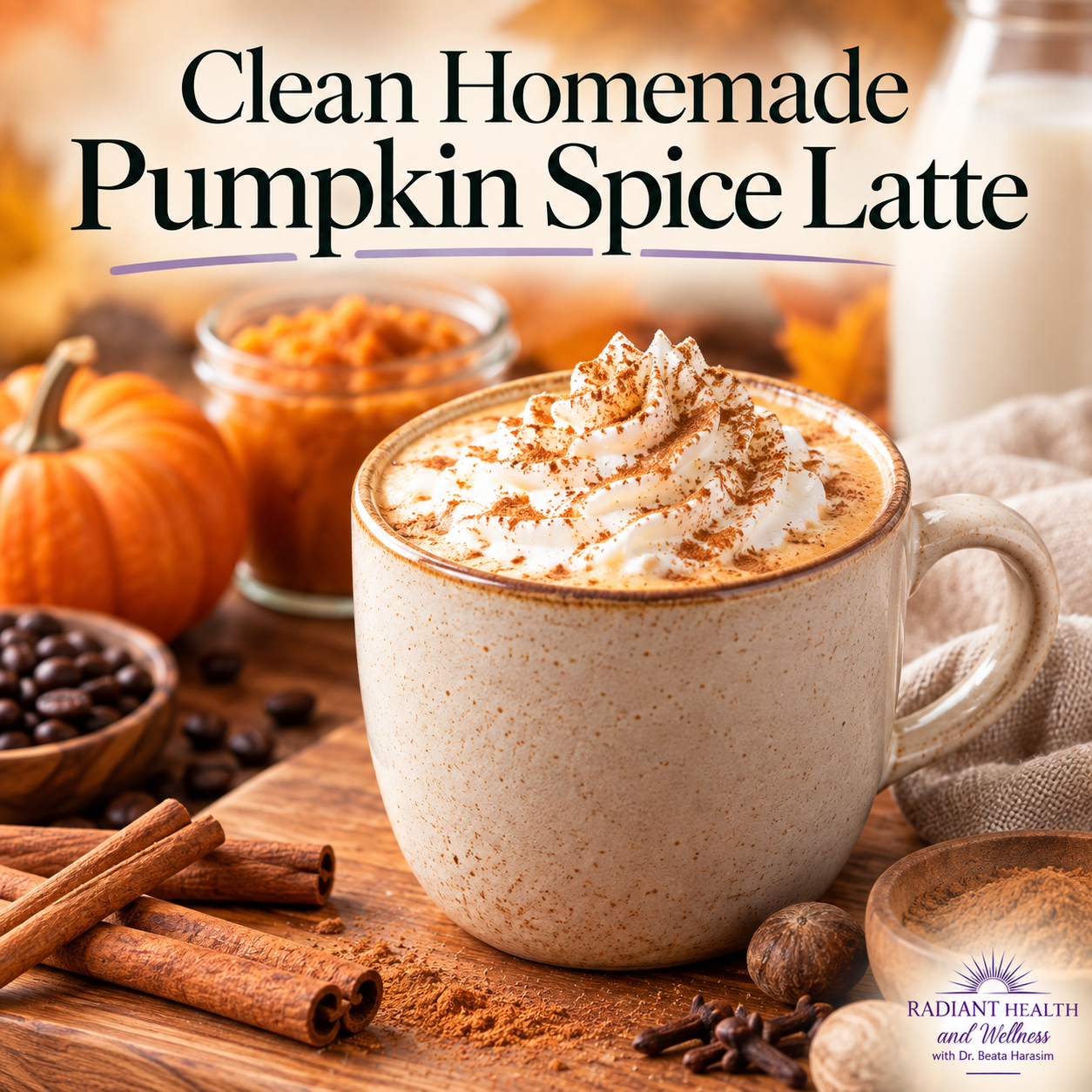
My Clean Homemade Pumpkin Spice Latte ☕️🎃
Naturally gluten-free • Egg-free • Peanut-free • Easily dairy-free • Easily nut-free
Customize it for your dietary needs, allergies, preferences—and what you already have in your kitchen.
One of my favorite things about making a pumpkin spice latte at home is that I get to choose exactly what goes into my cup.
For me, that means quality coffee, real pumpkin, organic spices and a milk that fits the way I choose to eat. I can decide where my ingredients come from, how sweet I want it and what I want to leave out.
But please don't look at this recipe and think you need to have every single ingredient before you can make it.
You don't.
Don't have cloves? Leave them out. Love cinnamon? Add a little more. Don't have pumpkin purée open? You can still make a delicious spiced latte. Prefer more pumpkin or less sweetness? Adjust it.
Use this recipe as a starting point, then mix and match based on your taste, your dietary needs and what you already have at home.
Ingredients
- 8–10 ounces freshly brewed organic coffee. I look for coffee that is carefully sourced and tested for things like pesticide residues and mycotoxins. This is one of the coffees I use, and you can get 10% off here.
- ½ cup milk of your choice. I use raw whole milk from a source I trust, homemade almond milk or homemade cashew milk. If you need a dairy-free or nut-free version, choose a milk that works for your body and dietary needs.
- 1–2 tablespoons organic pumpkin purée, or more if you love a stronger pumpkin flavor
- ¼–½ teaspoon organic Ceylon cinnamon
- ⅛ teaspoon organic ground ginger
- Pinch of organic nutmeg
- Tiny pinch of organic cloves
- ½ teaspoon organic vanilla extract
- Raw honey or pure maple syrup, to taste. Start small and add more only if you need it. Use maple syrup for a vegan version.
- Optional: cream or homemade whipped cream for topping
- Optional: extra cinnamon or nutmeg for sprinkling on top
And remember: the spices are flexible. If all you have is cinnamon and nutmeg, use those. If you love ginger, add more. This doesn't need to be complicated to taste good.
How to Make It
Brew your coffee and pour it into your favorite fall mug.
While the coffee is brewing, gently warm your milk, pumpkin, spices and vanilla in a small saucepan, whisking until everything is well combined and fragrant.
Remove it from the heat and add a small amount of raw honey or pure maple syrup. Taste it before adding more. We've been conditioned to expect more and more sweetness, and making foods and drinks at home is one way we can begin breaking that pattern.
For that coffee-shop texture, froth the pumpkin-milk mixture with a handheld frother or carefully blend it until creamy. Pour it into your coffee and stir.
Top with a little cream or homemade whipped cream if you'd like, sprinkle with cinnamon or nutmeg and enjoy.
Real coffee. Real pumpkin. Real spices. And you decide exactly how it tastes. 😊
Customize It for Your Body and Your Family
There isn't one perfect version of this recipe for every person. One of the benefits of making it yourself is being able to adapt it to your allergies, dietary needs and preferences.
Dairy-free: Use homemade almond or cashew milk, or another dairy-free milk you tolerate.
Nut-free: Skip the almond and cashew milk and choose a nut-free alternative that works for you. If you're managing a food allergy, always check the specific product label and cross-contact information rather than assuming a substitute is safe.
Peanut-free: The basic recipe doesn't call for peanuts. If you have a peanut allergy, you'll still want to verify the labels and manufacturing information for the individual ingredients you use.
Vegan: Choose a plant-based milk, use pure maple syrup rather than honey and skip the dairy cream or whipped topping.
Less sweet: This is one of the biggest benefits of making it yourself. Start with just a little raw honey or maple syrup, taste it and add more only if you actually want it. Over time, you may be surprised by how much less sweetness you need when the coffee, pumpkin and spices are allowed to provide the flavor.
More pumpkin: Add another spoonful of pumpkin purée. There's no rule saying you have to stop at two tablespoons.
More spice: Adjust the cinnamon, ginger, nutmeg and cloves however you like. You can also mix up a small jar of your favorite organic pumpkin-spice blend ahead of time so it's ready whenever you want a latte.
Don't have everything? Make it anyway. A cup of quality coffee with warm milk, cinnamon and a little raw honey can still give you that cozy fall flavor. Real-food cooking doesn't have to mean following a recipe perfectly or buying a pantry full of ingredients you don't already have.
A Quick Note on Food Allergies
If you're making this for someone with a diagnosed food allergy, customize the recipe based on their specific allergies and known safe foods, and verify the labels and cross-contact information for every packaged ingredient you use.
“Dairy-free,” “nut-free” or “peanut-free” describes how the recipe can be prepared; it doesn't guarantee that every brand of coffee, spice, milk, vanilla or other ingredient will be safe for every person with an allergy.
What Milk Do I Use?
This is another place where the front of the package doesn't tell me enough.
Something being labeled almond milk, cashew milk, oat milk or simply plant-based doesn't automatically make it a whole-food choice—or a product I want to consume every day.
In my own kitchen, I prefer raw milk from a source I trust or a simple homemade nut milk, particularly almond or cashew milk. Why?
Because when I make almond milk at home, it can literally be almonds and filtered water. Cashew milk can be just as simple.
Compare that with some commercial plant milks, where you may find a much longer ingredient list designed to make the product sweeter, creamier, thicker, more uniform and more shelf-stable. Depending on the brand, that can include added sugars or non-nutritive sweeteners, vegetable oils, natural flavors, carrageenan, gellan gum, guar gum, xanthan gum, lecithins, modified starches and other stabilizers, thickeners and emulsifiers.
These ingredients serve technological purposes. Emulsifiers help keep ingredients from separating, while gums, carrageenan and other stabilizers or thickeners can create the creamy, uniform texture consumers expect. The FDA itself classifies carrageenan as an ingredient that can function as a stabilizer, thickener, emulsifier and texturizer.15
But the fact that an additive makes a product creamier or keeps it from separating doesn't mean I want it in my milk.
I'm perfectly comfortable shaking a jar of homemade almond milk if it separates.
And there's another important point: plant milks aren't nutritionally interchangeable with dairy milk—or even with one another. Their protein, fat, carbohydrate, vitamin and mineral content can vary substantially depending on the plant itself, how the product is processed, whether it's fortified and what else has been added. The FDA specifically encourages consumers to compare labels rather than assuming all plant-based milk alternatives provide the same nutrition.16
So don't let organic, plant-based, almond, oat or another health-sounding word on the front of the carton make the decision for you.
Turn it around and read what's actually in it.
How many ingredients are there? Is there added sugar? Are oils, gums, emulsifiers, thickeners, flavors or sweeteners added? And are those ingredients actually something you want to consume regularly?
For me, simpler wins.
And if you've never made nut milk yourself because it sounds complicated, it's surprisingly easy. I'm creating separate step-by-step recipes for both my homemade almond milk and homemade cashew milk, so I'll link those here once they're available.
Sometimes getting back to real food really can be that simple: nuts, water, a blender and a few minutes in your kitchen.
Looking for raw milk near you? I’ve included resources to help you find local raw milk and other real-food sources in my Free Real Food Guide.
>>> Get the Free Real Food Guide
Why I Don’t Usually Choose Conventional Dairy, Oat Milk or Soy Milk
I personally don't reach for conventional dairy, oat milk or soy milk—even when an organic version is available—because I look beyond a single label and consider the food itself, how it was grown, how it was processed and what else has been added to it.
If you'd like to understand more about why I choose raw milk over conventional dairy, I dive deeper into that in my Free Real Food Guide.
>>> Get Your Free Real Food Guide
And if you'd like me to dive deeper into oat milk or soy milk, reply to your welcome email and let me know which one you'd like to learn more about. If there's enough interest, I'll turn those into future articles too. 😊
Want to Eat More Real Food Without Overcomplicating It?
If reading this has you looking at your pantry a little differently, my Free Real Food Guide is a great place to start.
I created it to help you move toward simple, nutrient-dense, real foods without feeling like you need to change everything overnight.
>>> Get My Free Real Food Guide
When Food Is Only One Piece of the Puzzle
Changing what you eat can be incredibly important.
But if you’ve been dealing with chronic symptoms, healing is rarely about just one thing.
Nutrition, digestion, sleep, stress, nervous-system function, environmental exposures, health history and patterns occurring throughout the body can all be pieces of a much larger picture.
And when you’ve already made changes but still don’t know what deserves your attention first, it can become incredibly frustrating trying to figure out the next step on your own.
Root Cause Clarity Session
That’s exactly why I created the Root Cause Clarity Session.
During this 60-minute session, we step back from individual symptoms and look at your health story from a whole-person perspective. We’ll explore your symptoms, history and patterns, connect some of the dots between pieces that may seem unrelated, and identify what may deserve your attention next.
Because healing isn’t about continually finding more things to do.
It’s about gaining enough clarity to understand where your energy may be best focused now.
>>> Book Your Root Cause Clarity Session
Frequently Asked Questions
What ingredients are in a pumpkin spice latte?
There isn’t one standard recipe. Ingredients vary between coffee shops and packaged products and can include coffee or espresso, milk or a plant-based alternative, pumpkin-spice sauce or syrup, sweeteners, natural flavors, stabilizers, preservatives and toppings. The best way to know what’s in the version you’re drinking is to check the current ingredient information from the company making it.
Are pumpkin spice lattes unhealthy?
A pumpkin spice latte is not inherently “healthy” or “unhealthy” simply because of its name. Ingredients, portion size, added sugar, frequency of consumption and your overall dietary pattern all provide important context. I prefer looking beyond a single number and considering what the drink is actually made from.
What does “natural flavor” mean?
Natural flavor is a regulated category of flavoring ingredients derived from natural sources. It does not necessarily tell you the individual substances used to create that flavor, which is why someone trying to identify specific ingredients may want more information than the label provides.
Can synthetic food dyes affect children’s behavior?
Research suggests that synthetic food dyes can affect activity and attention in some children. A 2022 systematic review concluded that the human clinical literature supports an association between synthetic food-dye exposure and adverse behavioral outcomes in some children.
Do food dyes cause ADHD?
Research suggests that certain dyes may worsen attention or activity-related symptoms in some children.
Is homemade pumpkin spice latte healthier?
Yes. Making a pumpkin spice latte at home gives you control over the ingredients, sweetness, coffee, milk and spices you use. It all depends on your ingredients, nutritional needs and overall diet.
What is a healthier alternative to a pumpkin spice latte?
One option is making your own with quality coffee, real pumpkin, organic spices, your preferred milk and a natural sweetener.
Can food affect brain fog, energy and mood?
Nutrition is one of many factors that can influence how we feel and function. The gastrointestinal tract, nervous system and gut microbiome communicate through multiple pathways, and can affect symptoms such as fatigue, brain fog and mood changes.
Continue Your Radiant Health Journey
Every article is designed to help you better understand your body, connect the dots, and discover what deserves your attention first.
Free Real Food Guide
Start building a foundation of simple, nutrient-dense real foods.
>>> https://www.holisticdrbeata.com/courses/real-food-guide
Is Your Avocado Oil Really Avocado Oil?
Take another look at what may—or may not—be hiding behind familiar food labels.
>>> https://www.holisticdrbeata.com/blog/is-avocado-oil-really-pure-adulteration-hidden-oils-dr-beata
Healing From the Inside Out
Explore the bigger picture of gut health and why digestion is connected to so much more than digestive symptoms.
>>> https://www.holisticdrbeata.com/f/digestion-gut-health-masterclass
Root Cause Clarity Session
If you're ready to look at your own symptoms, history and patterns more closely, this is where we can begin connecting the dots together.
>>> Root Cause Clarity Session
💖 Dr. Beata “Eat Clean” Harasim
References
1. Electronic Code of Federal Regulations. 21 CFR § 101.22 — Foods; Labeling of Spices, Flavorings, Colorings and Chemical Preservatives. Legal Information Institute, Cornell Law School.
21 CFR § 101.22
2. U.S. Food and Drug Administration. Dietary Supplement Labeling Guide: Chapter V. Ingredient Labeling.
FDA — Ingredient Labeling
3. An Overview of Key Industrial Product Citric Acid Production by Aspergillus niger and Its Application. Journal of Industrial Microbiology and Biotechnology. 2025;52:kuaf007. doi:10.1093/jimb/kuaf007.
Journal of Industrial Microbiology and Biotechnology — Citric Acid Production
4. Review of citric acid production using Aspergillus niger with maize flour and maize starch as substrates. Starch/Stärke.
Wiley — Citric Acid Production Using Maize Substrates
5. Review of industrial citric acid production, fermentation substrates and downstream recovery/purification. PubMed Central. 2025.
PubMed Central — Citric Acid Production Review
6. Starbucks Coffee Company. Iced Pumpkin Spice Latte — Nutrition Information.
Starbucks — Iced Pumpkin Spice Latte
7. Huang Y, Chen Z, Chen B, et al. Dietary sugar consumption and health: umbrella review. BMJ. 2023;381:e071609. doi:10.1136/bmj-2022-071609.
PubMed — Dietary Sugar Consumption and Health
8. Centers for Disease Control and Prevention. Get the Facts: Added Sugars.
CDC — Added Sugars
9. PubMed. Research addressing dietary sugar in relation to immune and inflammatory biology. PMID: 42048755.
PubMed — PMID 42048755
10. National Cancer Institute. Artificial Sweeteners and Cancer.
National Cancer Institute — Artificial Sweeteners and Cancer
11. World Health Organization. Use of Non-Sugar Sweeteners: WHO Guideline. 2023.
WHO — Use of Non-Sugar Sweeteners Guideline
12. Kim M, Kumar S, Chi G, Lee JJ. Artificial sweeteners and risk of cardiometabolic outcomes and mortality: a systematic review and meta-analysis. Nutrition Research and Practice. 2026;20(3):359–381. doi:10.4162/nrp.2026.20.3.359. The analysis included 3,625,613 participants across 37 studies.
PubMed — Artificial Sweeteners and Cardiometabolic Outcomes
13. Dong TS, Mayer EA. Advances in Brain-Gut-Microbiome Interactions: A Comprehensive Update on Signaling Mechanisms, Disorders, and Therapeutic Implications. Cellular and Molecular Gastroenterology and Hepatology. 2024;18(1):1–13. doi:10.1016/j.jcmgh.2024.01.024.
PubMed — Brain-Gut-Microbiome Interactions
14. Miller MD, Steinmaus C, Golub MS, et al. Potential Impacts of Synthetic Food Dyes on Activity and Attention in Children: A Review of the Human and Animal Evidence. Environmental Health. 2022;21:45. doi:10.1186/s12940-022-00849-9.
PubMed — Synthetic Food Dyes, Activity and Attention in Children
15. U.S. Food and Drug Administration. Types of Food Ingredients.
FDA — Types of Food Ingredients
16. U.S. Food and Drug Administration. Milk and Plant-Based Milk Alternatives: Know the Nutrient Difference.
FDA — Milk and Plant-Based Milk Alternatives
Categories: : Autumn Wellness, Functional Nutrition, Gut Health, Holistic Health, Holistic Nutrition, Integrative Nutrition, Real Food, Healthy Recipes