Is Avocado Oil Really Pure? Adulteration & Hidden Oils | Dr. Beata
 Dr. Beata Harasim
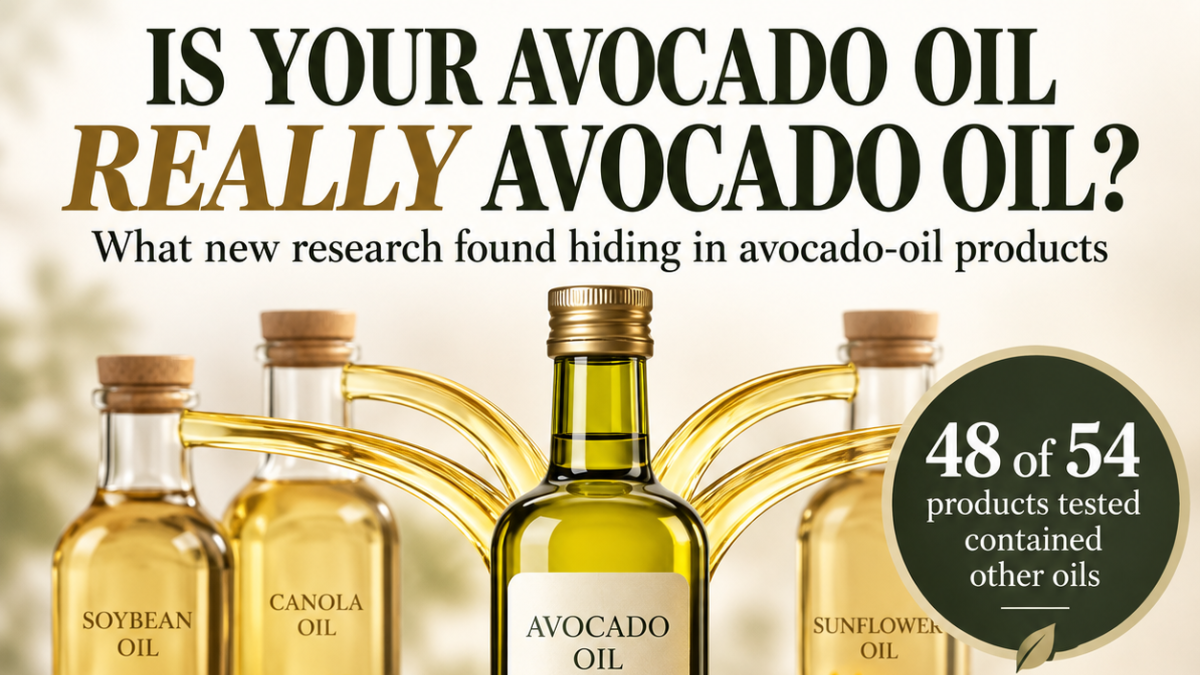
Is your avocado oil really pure? Research has found other oils in avocado oil products. Learn about adulteration, labeling, food allergies and more.
Is Your Avocado Oil Really Avocado Oil?
What new research on avocado-oil adulteration, food labeling, purity, and hidden oils means for consumers
You read the ingredient label.
It says avocado oil.
So you pay more for the chips.
You choose the mayonnaise made with avocado oil.
You buy the salad dressing specifically because avocado oil is the only oil listed.
Maybe you're intentionally avoiding soybean oil, canola oil, sunflower oil or other industrial seed oils.
Maybe you're navigating a food allergy or reaction.
Or maybe you've simply decided that you want to know what's going into your body.
You made an intentional choice based on the information printed on the label.
But what if the oil you're paying for isn't actually pure avocado oil?
That's not just a hypothetical question anymore.
Researchers at UC Davis have been investigating avocado-oil authenticity for years.
In 2020, they reported major problems with the quality and purity of bottled avocado oils sold in the United States.¹
In 2023, they tested private-label avocado oils and found that only 31% were pure and only 36% were of the advertised quality.²
And in 2026, researchers went beyond bottles of oil.
They tested 54 processed foods marketed as containing avocado oil as the oil ingredient.
48 contained other oils.
That's 89%.³
And now the issue has caught the attention of regulators.
In August 2026, the Texas Attorney General launched an industry-wide investigation into products marketed as being made with avocado oil over concerns about undisclosed seed oils and potentially misleading labeling.⁴
So if you've been paying more for an avocado-oil product because you're intentionally trying to avoid other oils, there's an important question worth asking:
Is the oil on the ingredient label actually the oil you're eating?
Avocado Oil Has Become a Premium Ingredient
Avocado oil has exploded in popularity.
You'll find it in chips, mayonnaise, salad dressings, crackers, cooking sprays and countless products marketed toward health-conscious consumers.
And companies know that the words “made with avocado oil” carry weight.
For many people, avocado oil signals a better-quality product.
It also frequently comes with a higher price tag.
That's important.
Because if I'm paying a premium for a food specifically because of the oil it's made with, I expect that oil to actually be what the label tells me it is.
And that's where this story becomes a problem.
Researchers Were Finding Problems Years Ago
This didn't begin in 2026.
In 2020, UC Davis researchers Hilary Green and Selina Wang evaluated commercially available avocado oils sold in the United States.
At least 82% of the samples were either oxidized before their expiration date or mixed with other oils.
Even more striking:
Three bottles labeled as “pure” or “extra virgin” avocado oil contained near 100% soybean oil.¹
Think about what that means from the consumer's perspective.
You could intentionally walk past a bottle of soybean oil.
Spend considerably more money on avocado oil.
Take it home believing you made a completely different choice.
And potentially be consuming something very different from what you thought you purchased.
That's not a small labeling issue.
That's a food-authenticity issue.
UC Davis has continued studying avocado oil since that first report, including developing better methods for detecting adulteration and working toward standards that account for natural variation in authentic avocado oil.
Then Researchers Looked at Private-Label Avocado Oil
UC Davis researchers continued investigating.
In 2023, they analyzed 36 private-label avocado oils sold by retailers in the United States and Canada.
Only 31% were pure.
Only 36% were of the advertised quality.²
And there's an important distinction here.
Purity and quality aren't the same thing.
Purity asks whether you're actually getting avocado oil or whether another oil has been mixed into or substituted for it.
Quality looks at the condition of the oil- including whether it has degraded because of aging, heat or light exposure.
An oil can therefore be authentic avocado oil and still be poor quality.
Or it can be adulterated with another oil entirely.
Both matter.
Then Came the 2026 Findings
This is the research that made me pay even closer attention.
Because researchers weren't looking only at bottles of avocado oil anymore.
They wanted to know what was happening in the processed foods people were purchasing specifically because those foods were marketed as containing avocado oil.
Researchers purchased products in 2025 and 2026 from California stores and online retailers.
They tested 54 foods in which avocado oil was presented as the oil ingredient.
48 of the 54 contained other oils.
That's 89%.³
And when you look at what they found by product category, it becomes even more striking:
93% of the chips contained other oils.
71% of the mayonnaise contained other oils.
100% of the salad dressings contained other oils.³
Read that again.
Because if you are intentionally choosing avocado-oil products, you deserve to know this.
One important limitation belongs here too: these 54 products represented only a portion of the avocado-oil processed-food market. This study doesn't tell us that 89% of every avocado-oil product sold everywhere is adulterated.
It tells us that 89% of the products researchers actually tested failed their authenticity criteria. That's concerning enough without making the research say more than it does.
How Did Researchers Know Other Oils Were There?
This wasn't someone tasting a chip and deciding it didn't taste like avocado oil.
Researchers analyzed fatty acids and sterols- chemical fingerprints that can help distinguish one oil from another.³
And they considered an important question:
Could frying, blending or emulsifying the food alter those fingerprints enough to make authentic avocado oil appear adulterated?
They tested that too.
The changes were minimal.
Researchers also knew that authentic avocado oil itself can vary based on factors including geographic origin and avocado variety.
So they built a 10% margin of deviation into their criteria to allow for some of that natural variation.
Even with that additional wiggle room:
89% of the avocado-oil products still failed.³
This isn't someone on the internet deciding avocado oil looks suspicious.
It's analytical testing.
The Company on the Package May Not Even Know
This is an important part of this story.
Finding another oil in a food labeled as being made with avocado oil does not automatically mean the company whose name appears on the package intentionally substituted a cheaper oil.
Our food supply is much more complicated than that.
Food manufacturers often purchase oils through suppliers, brokers and other intermediaries.
A company can order avocado oil from a supplier believing that it's purchasing avocado oil.
The supplier may be another step removed from the original processor.
And unless someone along that chain verifies authenticity, adulteration can potentially travel through the supply chain and into the final product.
UC Davis researcher Selina Wang specifically said the brands whose products failed may not know they are using adulterated oil. Many food companies obtain oils through third-party brokers or multiple suppliers, and Wang said the adulteration likely originates with oil suppliers.³
That distinction matters. But it doesn't make verification unimportant.
Quite the opposite.
If a company is going to put “made with avocado oil” on its packaging- and charge consumers a premium because of it- verifying that oil needs to be part of its quality-control process.
And Wang made that point too: food companies can do more to monitor and verify the authenticity of the oils they're purchasing.³
Consumers deserve accurate labels.
Food manufacturers deserve to know that the ingredients they're purchasing from their suppliers are authentic.
And suppliers need accountability for what they're selling.
The responsibility for food integrity doesn't disappear simply because the supply chain is complicated.
Now Regulators Are Investigating
On August 20, 2026, the Texas Attorney General announced an industry-wide investigation into companies marketing products labeled as being made with avocado oil.⁴
Civil Investigative Demands were issued to Primal Kitchen, Siete Foods and Chosen Foods, with the Attorney General's office stating that additional companies could follow.⁴
An important distinction: An investigation is not a finding of wrongdoing.
It doesn't establish that any of these companies intentionally substituted another oil, knowingly mislabeled a product or violated the law.
That's what the investigation is intended to determine.
But the fact that this issue has moved from university research into a state consumer-protection investigation tells us something important:
Avocado-oil authenticity is no longer something I would dismiss as an internet conspiracy.
It's a legitimate food-quality and consumer-transparency issue.
Primal Kitchen Is an Interesting Example of How Complicated This Gets
Primal Kitchen deserves a little more context because it's a brand many health-conscious consumers recognize.
Kraft Heinz announced an agreement to acquire Primal Kitchen for approximately $200 million in November 2018, with the acquisition completed in early 2019.⁵
At the time of the announcement, Kraft Heinz said Primal Kitchen would operate as an autonomous company.⁵
Now, in 2026, questions raised by the UC Davis research have included some Primal Kitchen products, and Primal Kitchen was one of the companies to receive a Civil Investigative Demand from the Texas Attorney General.⁴
Primal Kitchen has responded publicly.
The company says every lot of avocado oil it uses is backed by a supplier Certificate of Analysis confirming authenticity and that it requires independent third-party laboratory testing to verify those certificates.⁶
It has also pointed out something scientifically important: avocado oil's chemical composition can naturally vary based on factors including avocado variety, origin, growing season and ripeness.
Primal Kitchen says it remains confident in its ingredients while continuing to review its supply chain.⁶
That's information consumers deserve to have too.
Because I'm not interested in deciding that a company is guilty before the evidence establishes that.
I'm interested in transparency.
I want to know what independent testing found, what the company says in response, how the oil is being tested and verified, and what's happening throughout the supply chain.
That's the kind of transparency consumers deserve.
And This Raises a Bigger Question About the Brands We Trust
There's another piece of this conversation that extends far beyond avocado oil.
Who actually owns the brands you're buying?
The natural-food industry has changed enormously.
Small companies build loyal followings because consumers trust their ingredients, sourcing or philosophy.
Then some of those companies grow. Some are acquired. Some change suppliers. Some change manufacturing facilities. Some reformulate products.
Some maintain the standards that made consumers trust them in the first place.
Others may not.
I don't give any food company a lifetime pass simply because I trusted the brand ten years ago.
Ownership, suppliers, formulations and manufacturing practices can all evolve over time. A familiar label doesn't necessarily mean everything behind that product has stayed the same.
That's why I continue paying attention to the foods I buy, even when they come from brands I've trusted for years.
If something changes, I want to know. And I don't assume that a company's past reputation automatically tells me everything I need to know about what it's selling today.
That's not fear.
That's being an informed consumer.
I'll be digging much deeper into natural-food companies that have been acquired, what actually changed afterward, and which companies have remained independent in a separate article- because that deserves an evidence-based investigation of its own.
What About Olive Oil?
Avocado oil isn't the first premium oil to raise questions about authenticity.
Olive oil has its own long history of adulteration, mislabeling and quality problems.
In the same 2026 UC Davis research, scientists tested 20 processed foods labeled as containing olive oil. Only one failed their purity testing, compared with 48 of the 54 avocado-oil products tested.³
That's encouraging- but there's an important distinction.
They were testing processed foods made with olive oil. They weren't testing bottles of extra virgin olive oil sitting on grocery-store shelves.
Bottled olive oil has been studied much more extensively.
In 2010, UC Davis found that 69% of the imported oils it sampled that were labeled “extra virgin” failed international extra-virgin standards, compared with 10% of the California-produced oils tested.⁷ A follow-up study found that 73% of samples from five top-selling imported brands failed international sensory standards for extra virgin olive oil.⁸
That doesn't mean all of those oils were diluted with seed oils. Some failed because of oxidation, poor-quality fruit, improper processing or storage, or because they simply didn't meet the quality standards required to be called extra virgin. UC Davis specifically cautions against interpreting those studies to mean that most olive oil is “fake.”
But actual adulteration of olive oil with less expensive oils has been documented, and the FDA continues to recognize substitution of other edible oils for olive oil as a form of food fraud.⁹
And this is where sourcing becomes especially important to me.
Olive oil can pass through growers, mills, exporters, importers, brokers, distributors, bottlers and retailers before it reaches your kitchen. The longer and less transparent that chain becomes, the harder it can be for the person buying the final bottle to know exactly what happened along the way. UC Davis researchers have specifically pointed to traceability and transparency as important vulnerabilities in globally traded premium foods.
That's one reason I pay attention not only to what an olive-oil label says, but to how traceable the oil actually is.
When possible, I prefer companies with a much shorter and more transparent path from the olives and farm to the finished bottle and consumer- companies that can tell you where their olives were grown, where the oil was milled, how it was stored and who is actually responsible for the finished product.
I've also heard from people with extremely sensitive food reactions who report tolerating certain highly traceable olive oils while reacting to others, including some imported oils. They're another reason I don't dismiss sourcing and supply-chain transparency as irrelevant simply because the ingredient label says “extra virgin olive oil.”
The good news is that decades of scrutiny have led to better olive-oil testing, standards and accountability, which UC Davis researchers believe is one reason olive oil performed so much better than avocado oil in their 2026 processed-food testing.³
So I'm not walking away from olive oil. I'm paying closer attention to where it comes from and how directly I can trace it back to its source.
I'll be digging much deeper into olive-oil quality, authenticity, sourcing and how I choose olive oil in a separate article because that conversation deserves its own deep dive.
In the meantime, if you're wondering what I actually look for when choosing foods and products for my own home, you can download my Free Toxin-Free Living Guide below. I'll also share some of the specific products and sources I personally use- including the olive oil I choose- in the emails that follow.
>>> Get The Free Toxin-Free Living Guide
For Someone Avoiding Seed Oils, This Matters
I've made the personal decision not to knowingly eat industrial seed oils.
So if I choose a product specifically because it says it's made with avocado oil, I'm making that decision intentionally.
I'm not looking for soybean oil hiding under another name. I'm not looking for sunflower oil. I'm not looking for canola oil.
And I'm willing to pay more for a product made with ingredients that align with the way I've chosen to nourish my body.
I expect the ingredient label to give me accurate information so I can make that choice.
If you'd like to understand more about why I personally avoid industrial seed oils- including processing, oxidation, inflammation, traditional fats and the connection I've been exploring between dietary fats and sunlight- I go much deeper into that conversation here:
>>> Read: Can Seed Oils Really Make You Burn More Easily?
For Someone With a Food Allergy, This Becomes More Than a Preference
This is where this conversation becomes even more important.
Because for someone navigating a food allergy or significant food reaction, ingredient accuracy isn't simply about getting what you paid for.
It can become a safety issue.
If someone is intentionally avoiding soy, corn, sunflower or another food because their body reacts to it, an undeclared oil isn't merely inconvenient.
It matters significantly.
We've personally experienced foods labeled as being made with “pure avocado oil” or "pure olive oil" triggering reactions when other seemingly comparable avocado oil/ olive oil products did not.
And now we also have objective research demonstrating that avocado oil and olive oil adulteration really does happen.¹ ² ³
That belongs in the conversation too.
A person's symptoms don't prove adulteration.
But neither does a reassuring label always prove purity.
Sometimes the Body Gives Us the First Clue
This is one of the principles behind the way I approach food reactions in general.
Someone eats something that should be safe.
They react. They look at the label again.
Nothing obvious explains what happened.
And sometimes they're told the food couldn't possibly have contributed because the ingredient they're concerned about isn't listed.
But a label doesn't get the final word over what someone's body experienced.
A reaction doesn't automatically tell us why it happened or which ingredient was responsible. That's where investigation comes in.
Symptoms are clues.
When something that appears safe on paper repeatedly produces a reaction, that deserves our attention. We look deeper at the ingredients, sourcing, manufacturing practices, potential cross-contact and, as this research reminds us, whether the food actually contains what the label says it contains.
We don't have to jump to conclusions. But we shouldn't dismiss a clue simply because the explanation isn't immediately obvious.
Navigating Food Allergies or Unexplained Food Reactions?
If you or your child are dealing with food allergies, sensitivities, unexplained reactions, digestive symptoms, eczema, reflux or other symptoms that seem connected to food, my free Food Allergies Decoded Masterclass can help you begin connecting those dots.
>>> Watch The Free Food Allergies Decoded Masterclass
So How Do You Know Whether Your Avocado Oil Is Real?
Here's the frustrating part.
You can't determine purity simply by looking at the bottle.
Researchers use chemical analysis to evaluate fatty acids, sterols and other markers that help identify whether an oil is authentic.³
Most of us don't have a food chemistry laboratory in our kitchen.
And price doesn't solve the problem either.
The 2023 UC Davis research found that lower-priced oils were more likely to be adulterated- but a higher price did not guarantee purity or quality.²
So I don't pretend that buying the prettiest glass bottle or the most expensive brand guarantees anything.
What we can do is become more discerning consumers.
For me, transparency matters. I pay attention to where an oil comes from, how it's processed and whether the company is actually verifying the authenticity and quality of what it's selling- not simply trusting what arrives from a supplier.
And when a company is charging a premium based on the quality of an ingredient, I expect them to be able to stand behind that ingredient with meaningful sourcing and testing practices.
“Premium” on the front of a package isn't enough. I want transparency behind the label.
And I continue to come back to one of the simplest principles in the way I eat:
Know your food.
So What Oils Do I Actually Use?
With everything I've shared here, you may be wondering what I actually cook with and use when preparing food.
I don't rely on one oil for everything. I choose fats based on how I'm using them, how they're produced and sourced, and the role they play in a nutrient-dense, traditional-food diet.
I go much deeper into the fats and oils I personally use- including what I cook with, what I use cold and what I look for when choosing quality sources- in this article:
>>> Read: Can Seed Oils Make You Sunburn More Easily?
And remember, you don't have to buy avocado oil to get the nutritional benefits of avocados. You can eat the whole avocado itself, along with its naturally occurring fats, fiber, vitamins, minerals and other plant compounds.
Sometimes the simplest option is still the whole food: eat the avocado.
What About Chips, Mayonnaise and Salad Dressing Made With Avocado Oil?
This is where the 2026 research becomes especially relevant to everyday choices.
Many of us are already reading ingredient labels carefully. We see avocado oil listed instead of soybean, canola or sunflower oil, and we intentionally choose that product- often paying more for it because the ingredients align better with how we want to eat.
We should be able to trust that choice.
But the UC Davis findings show that reading the label may not always tell us the whole story. When researchers tested processed foods marketed as containing avocado oil, they repeatedly detected other oils that weren't reflected in the way consumers would reasonably understand the product.³
That doesn't make reading labels pointless. It means sourcing and transparency matter alongside the ingredient list.
If I'm choosing a bag of chips, mayonnaise or salad dressing specifically because it's made with avocado oil, I want to know that the company has done more than purchase an ingredient labeled “avocado oil” from a supplier. I want confidence that the oil has been properly sourced and that its authenticity is being verified.
Consumers shouldn't have to wonder whether the avocado oil they intentionally chose is actually avocado oil.
This Is One Reason I Keep Coming Back to Real Food
The more I learn about our modern food supply, the more I come back to the simplicity of real, nutrient-dense food from sources I trust.
I want the foundation of my diet to be foods that are as close to their natural form as possible, including quality animal foods, vegetables, fruits and traditional fats, with an emphasis on knowing where my food comes from whenever I can.
That doesn't mean I never eat anything from a package. Occasionally, I do.
But there's a difference between making packaged foods part of your life and building the foundation of your diet around highly processed foods with long and often difficult-to-trace supply chains.
Food quality goes far beyond the calories and macros on a nutrition label. How a food was grown or raised, processed, sourced, handled and ultimately brought to market can all be part of its story.
And as this avocado-oil research demonstrates, that story can matter even when you've carefully read the ingredient label.
Want Help Building a More Nutrient-Dense Real-Food Kitchen?
My Free Real Food Guide walks you through many of the foods I prioritize and includes resources for finding local grass-fed, pasture-raised and nutrient-dense food sources.
>>> Download My Free Real Food Guide
If You're Starting to Feel Like You Don't Know What to Eat Anymore...
I get it.
The more you learn about our modern food supply- from processing and pesticides to sourcing, plastics, seed oils and now food adulteration- the easier it can become to wonder:
What am I supposed to eat anymore?
Especially when you're already making intentional choices, reading ingredient labels and paying more for products you thought were higher quality.
But I don't share this information to make you afraid of your food or convince you that you need to eliminate every possible exposure from your life.
The goal is clarity.
Health is rarely about one thing, and healing isn't about trying to address everything at once. It's about understanding your body well enough to recognize how your symptoms, history, patterns, environment and daily choices may be connected- and then identifying what deserves your attention now.
That's also why you don't need to make every choice I make or overhaul your entire life based on every new study you read. What matters most for one person may be very different from what matters most for someone else.
You need to understand what matters for you.
That's exactly what we do in a Root Cause Clarity Session. We'll step back and look at your symptoms, history and patterns from a whole-person perspective, connect the dots between what may seem like separate pieces, and give you a clearer sense of where to focus your energy next.
>>> Book Your Root Cause Clarity Session
The Bigger Lesson Isn't Just About Avocado Oil
I don't want you walking away from this article thinking avocado oil is bad, because that's not the story.
The bigger story is that food quality, sourcing, processing and transparency matter. An ingredient label gives us important information, but as this research demonstrates, there can be more happening behind that label than consumers can see.
The answer isn't to throw our hands up and decide that nothing can be trusted. It's to become more informed and discerning about the food we're buying.
I still read labels, even on products I've purchased for years. But I also pay attention to the companies behind those products, where their ingredients come from, whether formulations or ownership have changed, and how transparent they are about sourcing and quality. And when my body responds differently to something I've eaten before, I pay attention to that too.
A familiar brand name or a health claim on the front of a package doesn't automatically tell me everything I want to know about the food inside it.
I want to know what I'm eating and where my food comes from. I expect companies to know what's moving through their own supply chains and to verify the ingredients they're putting their names on.
And when I spend more money specifically to choose one ingredient over another, I expect the product I'm buying to contain what it says it contains.
That shouldn't be a radical expectation.
It should be the baseline.
Frequently Asked Questions
Is avocado oil fake?
No. Authentic avocado oil absolutely exists.
The concern is that multiple studies have documented significant purity and quality problems in parts of the avocado-oil marketplace. Some products contained other oils. Others were oxidized or failed quality criteria.¹ ² ³
The problem isn't avocado oil itself.
It's whether you're actually getting the product you think you're buying.
Is avocado oil commonly adulterated?
Adulteration has been repeatedly documented in UC Davis research.
In 2020, researchers found three samples containing near 100% soybean oil.¹ In 2023, only 31% of the 36 private-label oils tested met the researchers' purity criteria.² And in 2026, researchers reported other oils in 48 of 54 avocado-oil-labeled processed foods they tested.³
That doesn't establish that every avocado-oil product is adulterated.
It establishes that this is a real problem worth paying attention to.
Does “made with avocado oil” mean avocado oil is the only oil in the product?
You still need to read the entire ingredient panel.
But that's exactly why the 2026 findings are concerning: researchers specifically examined products in which avocado oil was presented as the oil ingredient and detected other oils in 48 of the 54 products tested.³
Are companies intentionally replacing avocado oil with cheaper oils?
We cannot assume that.
The research establishes problems with authenticity. It does not establish that every company selling an affected product knowingly substituted another oil.
UC Davis researcher Selina Wang said brands whose products failed may not know they're using adulterated oil and that the adulteration likely originates with oil suppliers.³ That's why supply-chain verification matters.
What does Primal Kitchen say about its avocado oil?
Primal Kitchen says every lot of avocado oil it uses has a supplier Certificate of Analysis confirming authenticity and that it requires independent third-party laboratory testing to verify those certificates. Following questions raised by the 2026 UC Davis study- including questions involving some Primal Kitchen products- the company says it is continuing to review its supply chain.⁶
Is Primal Kitchen owned by Kraft Heinz?
Yes. Kraft Heinz announced its approximately $200 million acquisition of Primal Kitchen in November 2018, and the acquisition was completed in early 2019.⁵
Corporate ownership alone doesn't establish that a product's quality declined. I look at the ingredients, sourcing, formulation and evidence rather than assuming an acquisition automatically tells me what happened to a product.
Is olive oil adulterated too?
Olive oil has its own documented history of authenticity, mislabeling and quality problems.
In the 2026 UC Davis study, researchers applied the same purity testing to 20 processed foods labeled as containing olive oil, and only one failed- compared with 48 of the 54 avocado-oil products tested.³ Researchers pointed to the decades of testing, scrutiny and standards surrounding olive oil as an important difference between the two industries.
But that's processed food made with olive oil, not the same thing as testing bottles of olive oil on store shelves.
Bottled olive oil has raised concerns of its own. In UC Davis testing from 2010, 69% of the imported oils sampled and labeled “extra virgin” failed to meet international extra-virgin standards, and subsequent testing found similar quality problems among several top-selling imported brands. Those failures did not mean that all of those oils had been diluted with seed oils; problems included oxidation, poor-quality oil, processing or storage issues, and possible adulteration with cheaper refined olive oil. UC Davis also cautions that those older results should not be used to characterize all olive oil sold today.
That's why traceability matters to me just as much as what the front of the bottle says. I prefer olive oil with a shorter, more transparent path from the farm and mill to the finished bottle, where I can better understand where it came from and how it was produced and handled.
I'll be digging much deeper into olive-oil sourcing, authenticity and how I choose a high-quality olive oil in a separate article.
Can I tell whether avocado oil is pure by its color, smell or taste?
Not reliably enough to establish authenticity. Professional testing uses chemical markers such as fatty acids and sterols.³
Sensory clues can tell us something about an oil, but they aren't a substitute for analytical testing.
Does expensive avocado oil guarantee that it's pure?
No. The 2023 research found that lower-priced oils were more likely to be adulterated, but a higher price did not guarantee purity or appropriate quality.²
Is rancid avocado oil the same thing as adulterated avocado oil?
No. Adulteration is a purity issue. Oxidation is a quality issue.
An oil can genuinely be avocado oil and still have degraded. Or it can contain another oil and therefore fail authenticity testing.
Why does avocado-oil adulteration matter for food allergies?
Because people with food allergies may intentionally choose a product specifically to avoid another ingredient.
An undeclared oil could therefore be much more than a preference issue. At the same time, a reaction alone does not prove an undeclared oil was present. Cross-contact, another ingredient, manufacturing differences and individual reactions all need to remain part of the investigation. Symptoms give us clues. They don't automatically give us the answer.
Should I stop eating avocado oil?
That's not my takeaway. I care about authenticity, sourcing and quality. This research makes me more discerning about avocado-oil products.
It doesn't make avocado oil itself the enemy.
Continue Your Radiant Health Journey
Every article is designed to help you better understand your body, connect the dots, and discover what deserves your attention first.
Can Seed Oils Really Make You Burn More Easily?
Explore what dietary fats, oxidation, inflammation and cellular health may have to do with the way our skin responds to sunlight.
>>> Read Can Seed Oils Really Make You Burn More Easily
Free Real Food Guide
Want help choosing more nutrient-dense foods and finding better sources of real food?
>>> Download My Free Real Food Guide
Food Allergies Decoded
If food reactions have you questioning what's safe, learn how to begin looking beyond the symptom and connecting the dots.
>>> Watch My Free Food Allergies Decoded Masterclass
💖 Dr. Beata “Connecting the Dots” Harasim
References
1. Green HS, Wang SC. First Report on Quality and Purity Evaluations of Avocado Oil Sold in the US. Food Control. 2020;116:107328.
View the research
2. Green HS, Wang SC. Purity and Quality of Private Labelled Avocado Oil. Food Control. 2023;152:109837. doi:10.1016/j.foodcont.2023.109837.
View the research
3. University of California, Davis. The Avocado Oil in That Chip You're Eating May Not Be Made With Pure Avocado Oil. 2026.
View the UC Davis report
4. Office of the Attorney General of Texas. Attorney General Ken Paxton Investigates Avocado Oil Products for Deceptive Marketing and Potential Use of Undisclosed Seed Oils. August 20, 2026.
View the announcement
5. The Kraft Heinz Company. Kraft Heinz Signs Definitive Agreement to Acquire Primal Kitchen. November 29, 2018.
View the announcement
6. Primal Kitchen. Avocado Oil FAQ.
View the company's FAQ
7. Frankel EN, Mailer RJ, Shoemaker CF, Wang SC, Flynn JD. Tests Indicate that Imported “Extra Virgin” Olive Oil Often Fails International and USDA Standards. UC Davis Olive Center. 2010.
View the UC Davis findings
UC Davis found that 69% of the imported oils sampled and labeled extra virgin failed internationally accepted extra-virgin standards, compared with 10% of the California-produced oils sampled. Importantly, UC Davis states that this study did not find evidence that the samples were adulterated with non-olive oils.
8. Frankel EN, Mailer RJ, Wang SC, Shoemaker CF, Guinard JX, Flynn JD, Sturzenberger ND. Evaluation of Extra-Virgin Olive Oil Sold in California. UC Davis Olive Center. 2011.
View the UC Davis report
In the follow-up testing, 73% of samples from five top-selling imported brands failed international sensory standards for extra-virgin olive oil.
9. U.S. Food and Drug Administration. Economically Motivated Adulteration (Food Fraud).
View the FDA resource
The FDA specifically identifies dilution of more expensive extra-virgin olive oil with less expensive vegetable oil while selling it as pure olive oil as an example of economically motivated adulteration. The FDA also notes that hidden substituted ingredients can pose health risks, including allergic reactions.
Categories: : Diet, Food Allergies, Food Allergies & Sensitivities, Food reactions, Food Sensitivities, Functional Nutrition, Holistic Health, Holistic Nutrition, Integrative Nutrition, Real Food