Can Your Physical Health Affect Your Mindset & Capacity? | Dr. Beata
 Dr. Beata Harasim
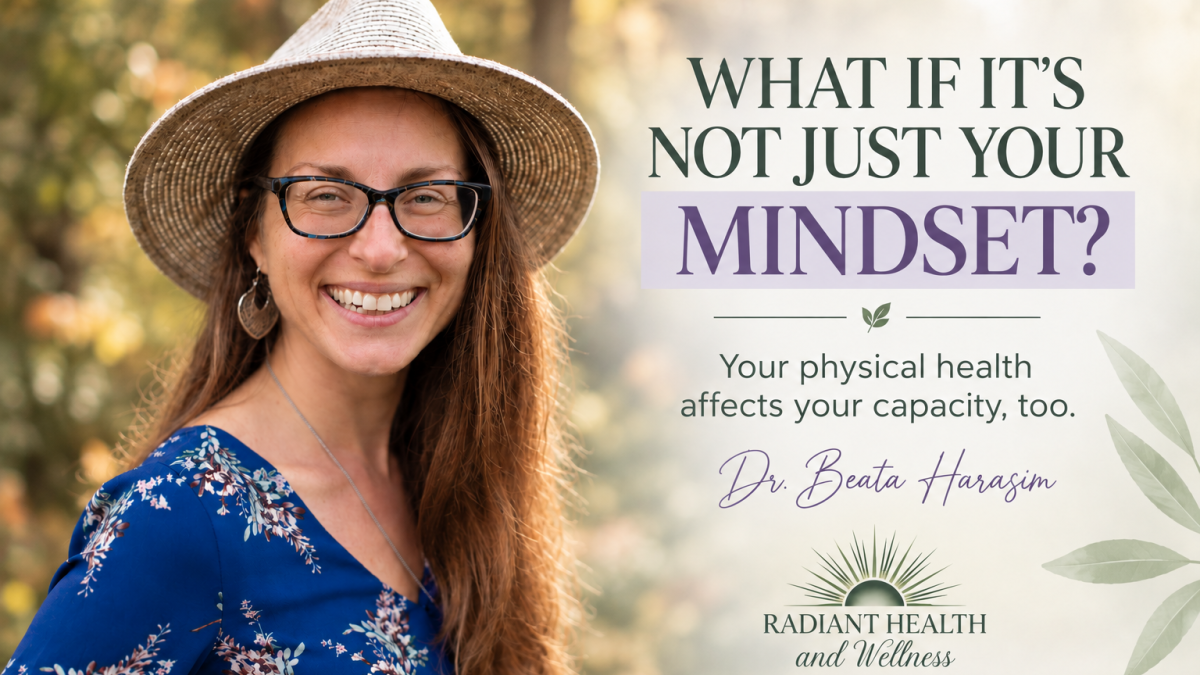
It's not just mindset. Learn how gut health, sleep, stress, physical symptoms & nervous-system health can affect your capacity for business and life.
What If It's Not Just Your Mindset? How Your Health Can Affect Your Capacity for Business and Life
If you're in the personal-growth, healing or entrepreneurial world, you've probably learned to look beneath the surface.
Maybe you've explored childhood wounds, abandonment, relationships, trauma, limiting beliefs or patterns of self-sabotage. You've worked with a therapist, practiced meditation, learned to regulate your nervous system or explored somatic, emotional or energetic healing.
You understand that what you've lived through matters.
But what happens when you've done so much of that work—and your body is still struggling?
You're exhausted even though you're doing all the “right” things. Your brain feels foggy when you need to create. Your skin keeps flaring. You're not sleeping well. Your digestion is unpredictable. You're reacting to foods you used to tolerate. Or everyday demands feel harder to handle than you think they should.
Eventually, it's easy to start wondering what you're still missing.
Sometimes the answer isn't more inner work. Sometimes your physical health deserves a closer look.
Because your mind, emotions and physical body were never separate systems.
The Body Has Lived Through Your Story, Too
Healthcare has a tendency to divide us into pieces.
Anxiety may be addressed in one place while digestive symptoms, hormones, skin problems or chronic pain are addressed somewhere else. And the experiences that shaped us—childhood stress, difficult relationships, loss, trauma, chronic pressure or years of pushing through—may stay in an entirely different conversation.
But you only have one body.
The body that experienced your life is the same body digesting your food, absorbing nutrients, communicating with your immune system, regulating energy and carrying you through everything you're asking of yourself today.
Our experiences don't happen in isolation from our physiology.
Chronic stress can influence nervous-system and stress-response pathways throughout the body. Sleep affects cognition, mood and our ability to respond to stress. Nutrition and digestion influence the nutrients available to the body, while immune and inflammatory processes can influence how we feel and function.
And these relationships aren't simply one-directional.
What we experience emotionally can affect the body.
And what's happening physically can affect how we feel emotionally, mentally and energetically.
That's why truly integrative healing has to make room for both.
What Happens When We Only Work on One Side?
I see two very different versions of this separation.
On one side is someone who has spent years working on their physical health. They've changed their diet, taken supplements, had extensive lab testing and perhaps worked with functional or natural-health practitioners. They may know more about their microbiome, hormones and nutrient levels than they ever imagined they would.
And yet, nobody has really asked about the person whose labs they're analyzing.
I want to understand what they've lived through and what was happening in their life when their health began to change. Chronic stress, difficult relationships, emotional wounds, nervous-system patterns and the pressure they're carrying every day don't exist separately from the physical body we're trying to help.
Those pieces belong in the health story, too.
On the other side is someone who has done tremendous emotional and personal-development work. They understand their childhood and recognize many of the patterns and beliefs they've carried forward. They've worked on trauma, meditation, nervous-system regulation, journaling, tapping, breathwork or energetic healing.
But somewhere along the way, every physical symptom can start getting interpreted through that same lens.
Exhaustion becomes a capacity problem. Difficulty showing up becomes a visibility wound. Overwhelm means they aren't regulated enough. Brain fog becomes subconscious resistance to their next level.
Sometimes those patterns absolutely deserve exploration.
But sometimes you're exhausted because something is happening physically in your body. Sometimes brain fog deserves a physiological investigation. Sometimes your body needs support—not another explanation for why your mindset is getting in the way.
You can work on the wound without ignoring the body.
And you can work on the body without ignoring the person carrying the wound.
Healing the whole person means making room for both.
Your Capacity Isn't Only Mental or Emotional
This becomes particularly important for entrepreneurs, leaders, parents, caregivers and anyone trying to create something meaningful in their lives.
We talk a lot about capacity—the capacity to be seen, receive more, hold greater responsibility, grow a business or remain regulated as life expands.
But capacity is physical, too.
You can have an incredible business strategy and still have to implement it through a human body.
If you're waking throughout the night and starting every morning depleted, consistency is going to require more from you. If brain fog turns a simple email into an hour-long task, that affects your ability to create. A skin flare can make visibility uncomfortable, digestive symptoms can change whether you want to travel or attend a networking event, and chronic pain can quietly consume cognitive and emotional bandwidth all day long.
Those aren't necessarily failures of mindset or evidence that you haven't expanded your capacity enough. They're real physical experiences that can affect the capacity you have available.
Mindset still matters. Nervous-system regulation still matters. Emotional healing still matters. But none of them happen separately from physiology.
Your physical state can influence the resources you have available to think, create, connect, make decisions and navigate stress.
And this doesn't only matter in business.
Your health comes with you into your relationships, finances, parenting, creativity and the life you're trying to build.
You bring the same body with you into all of it.
Gut Health Is About Much More Than Digestion
This is one of the reasons I'm so passionate about changing the way we think about gut health.
When most people hear “gut health,” they naturally think about digestive symptoms like bloating, constipation, diarrhea, reflux, gas or stomach pain. Those are important clues, but the gut doesn't operate inside its own little box.
Your digestive system is responsible for breaking down food and helping you absorb the nutrients your body needs. The gastrointestinal tract also interacts extensively with the immune system, while the gut and brain communicate with one another in both directions.
Research now describes a complex brain-gut-microbiome system involving neural, hormonal, immune and microbial signaling. The brain can influence gastrointestinal motility, secretion and permeability, while signals originating in the gut can communicate back through multiple pathways.1
The intestinal environment and microbiome also interact with metabolic and immune processes throughout the body. Researchers are continuing to investigate exactly how these relationships translate into individual symptoms and disease, and many microbiome-related causal relationships in humans remain an active area of study.2
What we do know is that gut health reaches far beyond whether you have a stomachache.
That's why a conversation about the gut may still be relevant when someone's biggest complaint isn't digestive. The clues may be showing up in energy, cognition, mood, sleep, immune function, skin or food reactions.
That doesn't mean every one of those symptoms is only caused by the gut. I don't reduce chronic health problems to only a single root cause. The human body is far more complex than that.
But because our systems are interconnected, an important imbalance in one area can have effects that extend beyond that one system.
That's what makes gut health such an important piece of the bigger picture: it's connected to so much.
Stress and Gut Health Work in Both Directions
This is another place where the physical and emotional pieces begin to overlap.
Stress isn't something that happens only in your thoughts.
The nervous system, endocrine system, immune system and digestive system communicate with one another, and research into the microbiota-gut-brain axis continues to demonstrate that this communication moves in both directions. Stress can influence gastrointestinal function and the intestinal environment, while gut-derived neural, immune, hormonal and microbial signals can communicate back toward the brain.3
That doesn't mean every emotional struggle begins in the gut or that healing your microbiome will resolve every response to stress.
It means the old separation between “physical” and “emotional” health doesn't reflect how interconnected the human body actually is.
And that changes the questions we ask when someone isn't feeling well.
Looking at Gut Health Through a Whole-Person Lens
An integrative approach to gut health means looking beyond the digestive system itself and understanding what's happening within the context of the whole person.
Symptoms, nutrition, digestion and absorption matter, but they're part of a much larger story that can also include sleep, movement, environmental exposures, stress and patterns occurring throughout the body.
And I want to understand the life that your body has lived.
What was happening around the time health began to change? What experiences shaped the nervous system? What physical and emotional patterns have developed over time? Are symptoms that have been treated as completely separate actually part of a larger pattern?
This context can help us understand why two people with seemingly similar symptoms may need very different kinds of support.
It's also why I pay so much attention to the connections between symptoms.
When every complaint is separated into a different specialty, it's easy to lose sight of the person in the middle of all of them. But when we step back and look at the whole story and you as a whole person, patterns that once appeared unrelated can begin to look very different.
Your symptoms are clues. Your history is part of the story. And understanding how those pieces fit together can give us a much clearer picture of what your body may need to heal.
Healing the Whole Person
When we begin to see health this way, healing becomes less about continually adding more things to do and more about understanding what your body actually needs.
There is no universal protocol for the whole person.
Two people can experience similar symptoms and arrive there through very different combinations of factors. One may need more physical support. Another may need greater attention to chronic stress, nervous-system patterns or emotional wounds. And often, several pieces of the story deserve attention—sometimes together and sometimes at different stages of healing.
That's why clarity matters.
Without it, it's easy to move from one supplement, diet, protocol, practitioner or healing modality to the next, hoping the next thing will finally be the thing that works.
But healing doesn't require doing everything at once.
It requires listening to the clues your body is giving you, understanding how they fit into the larger picture and becoming more intentional about what deserves your attention now.
The body that lived through your past is the same body you're asking to build your future.
Ready to Look at Gut Health Differently?
If this article has you wondering whether gut health could be connected to more of what you're experiencing than you realized, I created my free Healing From the Inside Out masterclass to help you begin connecting those dots.
You'll learn why gut health reaches far beyond digestion, how seemingly unrelated symptoms can sometimes be connected and why truly supporting the gut means looking at the bigger picture of what's happening throughout the body.
>>> Watch Healing From the Inside Out →
Frequently Asked Questions
Can physical health affect mindset and emotional resilience?
Yes. Mental and emotional experiences don't occur separately from physiology. Sleep, pain, energy availability, nutrition, illness, stress-response physiology and other physical factors can influence cognition, mood and the resources we have available to navigate everyday demands.
That doesn't make mindset or emotional work irrelevant. It means physical and emotional health influence one another.
Can poor gut health cause anxiety, brain fog or mood changes?
The relationship is more complex than saying that poor gut health directly “causes” these symptoms.
The gut and brain communicate bidirectionally through neural, endocrine, immune and microbial/metabolic pathways, and researchers are actively studying how alterations within this system relate to cognition, mood and stress responses. Much of the human microbiome literature remains associative rather than proving that a particular gut change causes a particular psychological symptom.
Gut health can therefore be an important piece to investigate without assuming it's the only explanation.
What is the gut-brain axis?
The gut-brain axis refers to the bidirectional communication between the gastrointestinal system and the brain. This communication involves the nervous system, hormones, immune signaling and metabolites produced within the intestinal environment and microbiome.
In other words, the gut and brain are constantly communicating rather than functioning as completely separate systems.
Can chronic stress affect gut health?
Yes. Stress-response pathways can influence gastrointestinal motility, secretion, permeability and other aspects of gut function. Research also suggests interactions between stress and the gut microbiome, although many of the more specific microbiome relationships are still being investigated.
This is another reason I don't separate nervous-system health from physical health when looking at the whole person.
What does gut health have to do with symptoms outside the digestive system?
The gastrointestinal tract does much more than digest food. It is involved in nutrient absorption and has extensive relationships with immune, neural and metabolic processes.
That doesn't mean every skin, mood, immune, hormonal or energy-related symptom originates in the gut. It means gut health can be relevant even when the most obvious symptom isn't digestive.
Why am I still exhausted after doing so much nervous-system and mindset work?
There isn't one universal explanation for fatigue. Sleep, nutrition, nutrient status, endocrine and metabolic factors, medications, illness, chronic stress, pain and many other factors can contribute.
If emotional and nervous-system work has been valuable but you're still struggling physically, that may be a clue that the physical side of the picture deserves investigation too.
Does nervous-system regulation fix chronic health problems?
Nervous-system regulation can be an important part of supporting health and stress resilience, but chronic symptoms can have many contributing factors.
The nervous system deserves a place in the conversation without becoming the explanation for everything.
What does a whole-person approach to health mean?
A whole-person approach looks at symptoms within the context of the person experiencing them. That can include physical health, nutrition, digestion, sleep, movement, environment, stress, nervous-system patterns, emotional experiences, health history and the relationships among those pieces.
The goal isn't to investigate everything simply because it exists.
The goal is to identify the patterns that matter for you.
Continue Your Radiant Health Journey
Every article is designed to help you better understand your body, connect the dots, and discover what deserves your attention first.
Healing From the Inside Out
Discover why gut health is about far more than digestion and how the gut may connect with symptoms throughout the body.
>>> Watch My Free Healing From the Inside Out Masterclass
What Does “Root Cause” Really Mean?
Explore why chronic symptoms rarely come down to one isolated cause—and why understanding the patterns within your health story can change where you focus your attention.
>>> Read: Why Healing is Different for Everyone
The Radiant Health Method
Learn how nutrition, physical health, nervous-system regulation, emotional health, environment and other pieces of health can interact as part of a larger whole.
>>> Explore the Radiant Health Method
Ready for a More Personalized Look at Your Health?
If you've been doing all the “right” things but still feel like you're missing a piece, my Root Cause Clarity Session is where we step back and look at your symptoms, history and patterns together.
The goal isn't another generic protocol. It's to help you understand the bigger picture and identify what deserves your attention first.
>>> Book Your Root Cause Clarity Session
💖 Dr. Beata “Connecting the Dots” Harasim
References
1. Dong TS, Mayer EA. Advances in Brain–Gut–Microbiome Interactions: A Comprehensive Update on Signaling Mechanisms, Disorders, and Therapeutic Implications. Cellular and Molecular Gastroenterology and Hepatology. 2024;18(1):1–13. doi:10.1016/j.jcmgh.2024.01.024.
View the research on PubMed
2. Metwaly A, Kriaa A, Hassani Z, et al.; IHMCSA Consortium. A Consensus Statement on Establishing Causality, Therapeutic Applications and the Use of Preclinical Models in Microbiome Research. Nature Reviews Gastroenterology & Hepatology. 2025;22(5):343–356. doi:10.1038/s41575-025-01041-3.
View the research on PubMed
3. Foster JA, Rinaman L, Cryan JF. Stress & the Gut-Brain Axis: Regulation by the Microbiome. Neurobiology of Stress. 2017;7:124–136. doi:10.1016/j.ynstr.2017.03.001.
View the research on PubMed
Categories: : Body Signals & Symptoms, Digestive Health, Emotional Wellness, Energy & Vitality, Gut Health, Health Mindset, Holistic Health, Holistic Medicine, Integrative Medicine, Mind-Body Connection, Nervous System Regulation, Rebuilding Life & Health, Root Cause Healing, Root Causes